There are two ways to sort backlinks: by the attribute in the HTML and by how the link got there. Here is what each type is worth to a SaaS site, which ones Google treats as spam, and how to audit the mix you have.

Founder, Digital Gratified
There are two ways to sort backlinks: by the attribute in the HTML (followed, nofollow, sponsored or ugc), and by the source, meaning how the link got onto the page. The attribute decides whether Google passes ranking credit; the source decides almost everything else, including whether the link survives, whether buyers see it and whether it breaks Google's spam policies.
Most lists of "40 types of backlinks" mix the two and pad the count with link types no SaaS company should touch. Our position is narrower: a B2B SaaS link profile should be built mostly from three source types (editorial coverage, integration and partner links, and reclaimed brand mentions), backed by resource page replacements and selective guest posts, with everything else treated as filler or risk. This guide explains both classifications, what each type is worth, which ones Google treats as spam, and how to audit the mix you already have.
How Many Types of Backlinks Are There?
By attribute there are four, and Google defines them. By source there is no fixed number, which is why guides list anything from 3 to 50. The useful answer depends on the decision you are making:
- Deciding how Google treats a link: use the four attribute types. They tell you whether a link can pass ranking credit at all.
- Deciding where to spend time or budget: use source types. Two followed links with the same attribute can be worth wildly different amounts depending on where they came from.
- Explaining a profile to leadership: group sources into three buckets: links others gave you without asking (editorial), links you earned by asking (outreach, partners, replacements), and links you placed yourself (profiles, comments, directories). The first two buckets carry the value; the third mostly carries risk.
Backlinks are one input to a wider program, and our guide to how link building fits into a wider SEO program covers how the pieces connect. This post stays on the links themselves.
Backlink Types by Attribute: Followed, Nofollow, Sponsored and UGC
A link with no rel attribute is a followed link, often called dofollow. Site owners can qualify a link with one of three values, and Google publishes what each one is for in its guidance on qualifying outbound links: sponsored for advertisements and paid placements, ugc for user-generated content such as comments and forum posts, and nofollow when the other values do not apply. Google says links with these attributes "will generally not be followed", which in practice means they pass little or no ranking credit.
Two points matter more than the definitions. First, the attribute is set by the publisher, not by you, so you cannot "build" a nofollow link into a followed one. Second, a profile with no nofollow links looks manufactured. In our analysis of dofollow shares across 420 SaaS sites, the median was 82.7%, so roughly one linking site in six was nofollow, and that is what an earned profile looks like. For the mechanics of rel values and referring domains, see how backlinks, referring domains and rel attributes work.
Backlink Types by Source: 12 Types and What Each Is Worth
The attribute tells you how a link is treated. The source tells you how it was made, which is what Google's spam policies judge, and what a buyer sees. Here are the twelve source types that show up in SaaS link profiles, with the attribute each usually carries and where it sits against those policies:
| Backlink type | How it usually gets there | Usual attribute | Status under Google's spam policies |
|---|---|---|---|
| Editorial and digital PR | A journalist or writer cites your data, product or expert | Followed, sometimes nofollow | Fine |
| Integration and partner | Marketplace listings, setup guides and announcements by tools you connect to | Mixed | Fine; partner pages built only to swap links count as link schemes |
| Review sites and software directories | Profiles on sites buyers use to compare tools | Mostly nofollow | Fine; low-quality directory links are a named spam example |
| Guest posts | An article you write for another site, with a link back | Followed or sponsored | Fine when editorial; paid ones that pass credit are link spam |
| Resource page and broken link replacement | You pitch a page as a better or live replacement on a curated list | Followed | Fine |
| Reclaimed brand mentions | A site that already names you adds the link on request | Followed | Fine |
| Image and embed | Others use your chart, screenshot or embeddable tool with a credit link | Followed | Fine; hidden or keyword-rich widget links are spam |
| Press release and syndication | Wire services and sites that republish content | Usually nofollow | Fine as distribution; paid releases with optimized, credit-passing links match the advertorial example |
| Forum, community and comment | You or users post in discussions | ugc or nofollow | Optimized links in comments and signatures are spam |
| Profile, social and bookmark | You create an account page with a link | Mostly nofollow | Low-quality bookmark links are a named spam example |
| Sitewide footer and template | A partner or client adds you to every page | Mixed | Widely distributed footer links are a named spam example |
| Reciprocal | Two sites agree to link to each other | Followed | Occasional is normal; excessive exchanges are spam |
Read the right-hand column and a pattern appears. The types that are always fine are the ones where somebody else chose to link. The types that drift into spam are the ones you can create at scale yourself. That is the most reliable rule of thumb in this whole topic.
Editorial Links and Digital PR
An editorial link is one a writer adds because your page helps their reader: a data point cited in a trade publication, a product named in a "how teams handle X" article, a quote from your founder in a news story. These are the contextual backlinks, sitting inside the body of a relevant article, that every other type tries to imitate. Digital PR is the deliberate version: publishing research or expert commentary that journalists want to cite.
SEO practitioners rank this type first. In the Editorial.Link survey of 518 SEO professionals, 48.6% named digital PR the most effective link building tactic, against 16% for guest posting and 12% for creating linkable assets. The same respondents said where they point links: 52.7% mainly to service or product pages, 38.4% to blog posts and 7.1% to the homepage.
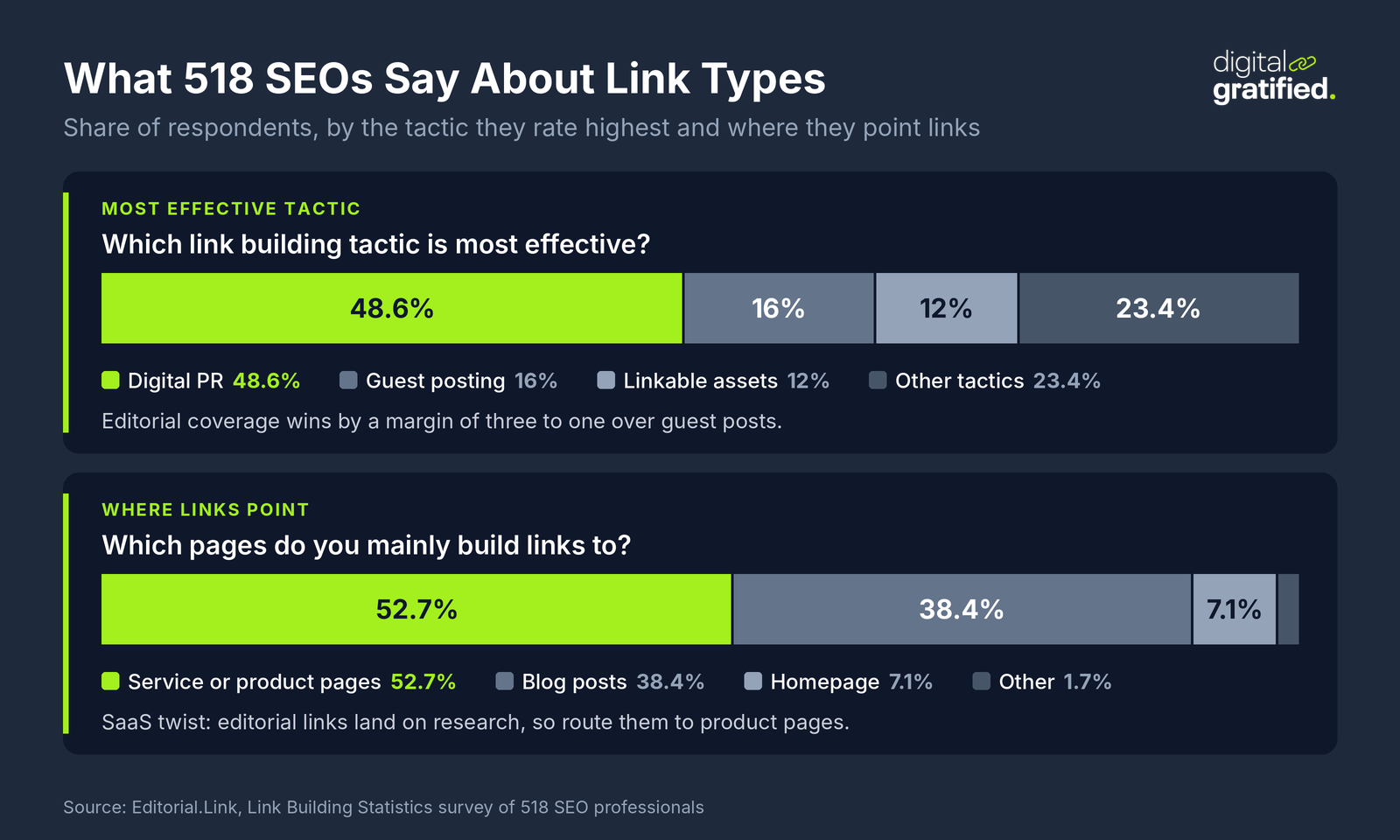
The second bar is the one SaaS teams misread. Editorial links rarely land on a pricing page, because journalists cite research and guides, not sales pages. A SaaS company has to earn editorial links to the pages people cite, then pass that authority onward with internal links that carry authority to pricing and comparison pages. Skipping that second step is why so many digital PR wins never show up in demo requests.
Integration, Partner and Marketplace Links
This is the backlink type most general guides miss, and the one SaaS companies are best placed to win. Every integration you ship can produce a listing in the partner's app marketplace, a setup guide in their documentation and a mention in their release notes. These pages are read by people already using a tool next to yours, which makes them some of the highest-intent referral sources a SaaS site can have.
The rules are simple. Make sure the listing contains a real HTML link, because Google can generally only follow links that are a elements with an href, and logo walls built with JavaScript click handlers may pass nothing. Ask for a link to the integration page, not the homepage. And avoid "partner pages" that exist only to trade links, which Google's policy names directly. In categories where buyers live in documentation, such as developer tools, these links often matter more than press; our page on link building for developer tool companies covers that vertical.
Review Sites and Software Directories
Profiles on the software review and comparison sites buyers use while shortlisting are usually nofollow, so their ranking value is small. Their buyer value is not. A buyer comparing three tools on a review site is closer to a demo than almost anyone reading your blog. Keep these profiles complete and current, and treat them as a sales channel that happens to include a link.
General web directories are the opposite: followed, cheap and read by nobody. Google's spam policy lists "low-quality directory or bookmark site links" as an example of link spam. If a directory would accept any site that pays or fills in a form, the link is worth nothing and may be a liability.
Guest Post Links
A guest post is an article you write for another site with a link back to yours. Done on a publication your buyers read, it is a legitimate editorial link. Done at volume through vendors, it is mostly a way to spend money on sites with no audience.
The supply data makes the point. BuzzStream analyzed 257,267 sites sold through guest post marketplaces and rated 96.2% of them low quality; only 1.37% met its high or top tier bar (DR 71 or more with at least 50,000 monthly organic visits), and 39.6% had no measurable organic traffic at all. The average vendor price was $461, rising to $3,130 for a high quality site and $6,018 for a top tier one.
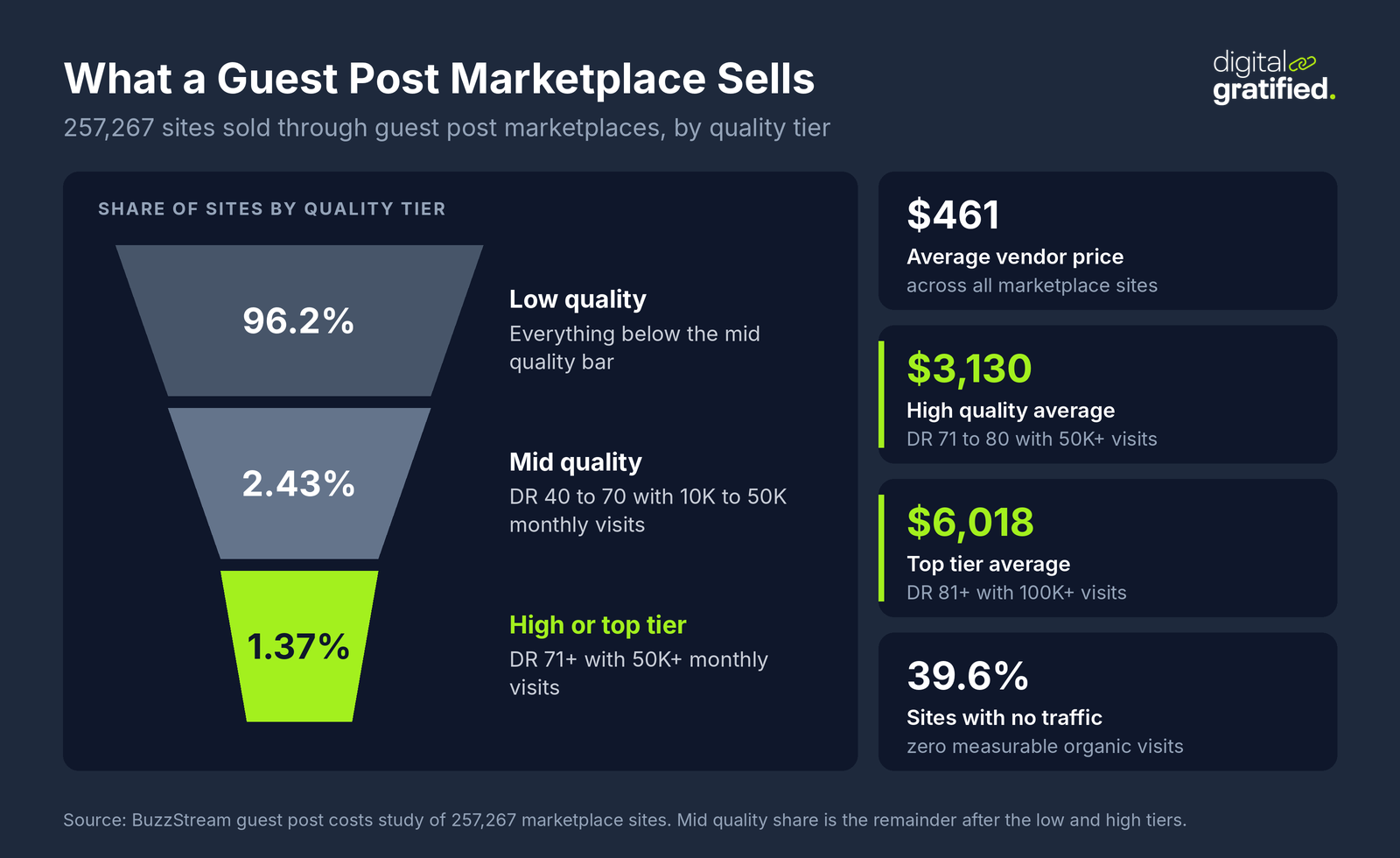
So the price you pay mostly buys you a place in the bottom of that funnel. If a placement is paid, Google requires the link to carry rel="sponsored" or rel="nofollow"; a paid guest post that passes ranking credit is link spam under the "buying or selling links for ranking purposes" example. Our view: write guest posts for publications you would be proud to show a prospect, and read our notes on buying placements through link marketplaces before you buy volume.
Resource Page and Broken Link Replacement Links
Curated resource pages ("the best guides on X") and pages with dead outbound links both give you a reason to ask for a link that has nothing to do with payment: you are offering a better or working page. For SaaS companies with a strong template, calculator or research page, this is one of the cleanest sources of followed links. Our guide to pitching your page as the replacement for a dead link walks through the process.
Reclaimed Brand Mentions
Many sites already name your product without linking. Asking them to add a link is usually the easiest win available, because the editorial decision has already been made. Unlinked mentions matter on their own, too: in Ahrefs' study of 75,000 brands, branded web mentions correlated with AI Overview visibility at 0.664, against 0.295 for referring domains and 0.218 for backlinks. That is correlation, not proof, but it suggests a mention on a site buyers trust is worth having whether or not it ever becomes a link. Start with finding mentions of your product that never got a link.
Image and Embed Links
When another site uses your chart or screenshot and credits you with a link, that is an image backlink. Google's link guidelines say it uses an image's alt text as the anchor text for image links, so the credit link works best when it is a plain text link or an image with descriptive alt text. Embeddable calculators and badges can earn links too, but Google lists "keyword-rich, hidden, or low-quality links embedded in widgets" as spam, so the embed code should carry a branded or plain link, never a stuffed anchor.
Press Release and Syndicated Links
Wire service releases and the sites that republish them almost always carry nofollow links. A release can still lead to editorial coverage if a journalist picks up the story, and that coverage is the link worth having. Treat the release itself as distribution, not link building, and keep its anchors branded.
Forum, Community and Comment Links
Links in forums, communities and blog comments are user-generated, so publishers mark them ugc or nofollow. A helpful answer in a community your buyers use can send qualified visitors, and that is the only reason to post one. Google's policy names "forum comments with optimized links" as spam, so a comment written to place a link fails twice: no ranking credit and a footprint.
Profile, Social and Bookmark Links
Profile creation sites, social bios and bookmark sites let anyone add a link to their account page. They are fine for claiming your brand name and nothing more. Lists of "500 profile creation sites for backlinks" are selling volume Google is designed to ignore.
Sitewide Footer and Template Links
A "Powered by" link in a customer's footer or a partner's template creates thousands of backlinks from one referring domain. A few are natural for a product that is visible on customer sites. Google's policy lists "widely distributed links in the footers or templates of various sites" as link spam, so the safe version is branded, and nofollow if it was a condition of a discount or contract.
Reciprocal Links
Two companies that work together linking to each other is normal. A network of swaps arranged to raise rankings is not; the policy names "excessive link exchanges". We have written separately about where a link swap turns into a scheme.
Backlink Types That Break Google's Rules
Google defines link spam as creating links "primarily for the purpose of manipulating search rankings". Some link types sit inside that definition by design, whatever a vendor calls them:
- Paid followed links: any link bought with money, goods or services that does not carry rel="sponsored" or rel="nofollow". Free seats or product credits traded for a link count as payment.
- Private blog network links: sites built to pass links, which fall under "creating low-value content primarily for the purposes of manipulating linking and ranking signals".
- Tiered links: links stacked behind a placement to boost it, which usually come from the automated and low-quality sources the policy lists.
- Automated links: anything created with software that posts links to many sites.
- Contract links: requiring a link in terms of service or a contract without letting the site owner qualify it.
Google handles most of this algorithmically, by discounting links it judges unnatural, and can also apply a manual action. A recent update to read correctly: the September 2026 spam update ran from September 24 to October 8, and it was not a link spam update. If your rankings moved in that window, look at content before you start disavowing links.
Which Types of Backlinks Matter Most for a SaaS Site
Most guides rank backlink types by one dimension, usually authority. For a company that sells on annual contracts, two dimensions matter: how much ranking credit the link can pass, and whether the people who sign contracts will ever see it. Put every type on those two axes and the priorities sort themselves.
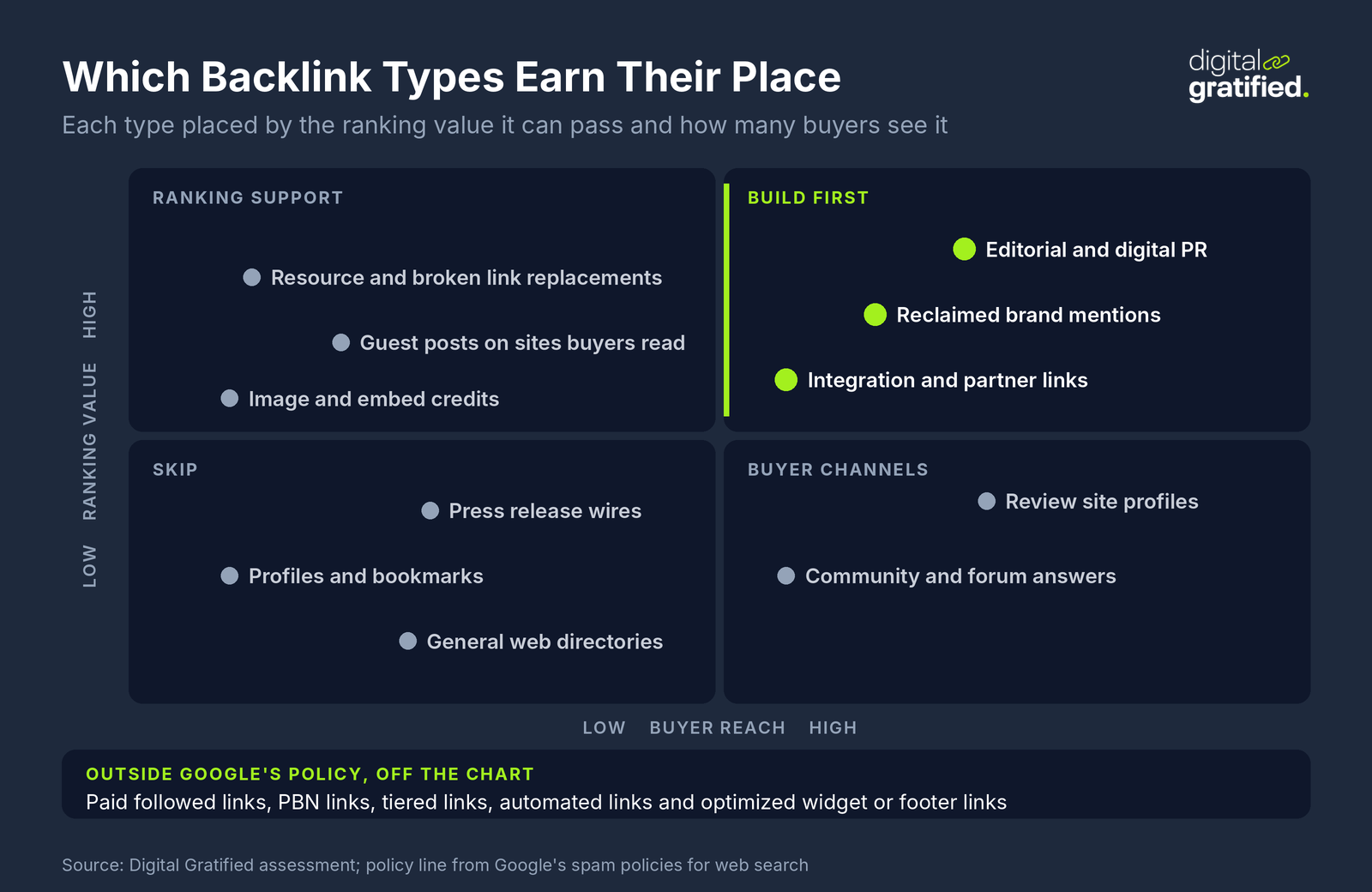
Three practical consequences follow. Build the top right quadrant first, because those links do both jobs and are the hardest for a competitor to copy. Keep the bottom right types (review profiles, community answers) for what they do well, which is sending buyers, and do not count them in a link report. And never spend budget on the bottom left, however cheap it looks; a link nobody reads that also passes no credit has a value of zero. To turn the top right quadrant into a number finance accepts, see putting a pipeline value on a single link.
This is how we run SaaS link building and digital PR for clients: editorial placements and expert commentary on DR 50+ publications with a real audience in the client's market, a domain list the client approves before outreach starts, and no PBNs or link farms.
How to Audit the Backlink Types in Your Profile
You do not need a new tool to see which types you have. A spreadsheet and two exports will do it in an afternoon:
- Export referring domains, not individual backlinks, from Google Search Console and one third-party tool, with the linking page for each.
- Tag each domain with one source type from the table above. When a domain links in several ways, tag the strongest.
- Add two columns: the rel attribute, and the page on your site the link points to (blog, research, tool, product, pricing, comparison).
- Calculate the share of each type and the share that lands on, or is internally linked to, a commercial page.
- Flag anything from the spam list that you or a past vendor built, and decide whether to remove it, qualify it or disavow it.
- Set next quarter's target by type, not by link count.
Here is a worked example with illustrative numbers. A Series A SaaS company has 240 referring domains. Tagging shows 70 from directories and profiles, 55 from guest posts bought through a vendor, 40 from integration partners, 30 editorial, 25 from forums and communities and 20 reclaimed mentions or replacements. On a raw count, it looks healthy. By type, only 90 domains (37.5%) come from the types worth building, and of those, the 40 partner links all point at the homepage instead of the integration pages. The fix is not more links: it is a quarter spent asking partners to link to integration pages, reclaiming mentions, and redirecting the guest post budget to one study that can earn editorial coverage.
The Bottom Line
Backlink types come in two layers. The attribute tells you whether a link can pass ranking credit; the source tells you whether it should exist at all. For a SaaS company, the types worth building are the ones where someone else chose to link to you: editorial coverage, integration partners and reclaimed mentions, backed by resource page replacements.
So audit your profile by type rather than by count, put next quarter's budget into the build first quadrant, and keep review sites and communities as buyer channels rather than link targets. If you want a team to earn those editorial links with you, talk to us about SaaS link building.
Frequently Asked Questions
What are the main types of backlinks?
By attribute there are four: followed (dofollow), nofollow, sponsored and ugc. By source, the types that matter most are editorial links and digital PR, integration and partner links, review site listings, guest posts, resource page and broken link replacements, reclaimed brand mentions, image credits, and lower value types such as press release, forum, profile, footer and reciprocal links.
What are the 3 types of backlinks?
The three-way split groups links by how they were made: natural or editorial links that others give you without asking, links you earn by asking (outreach, partners, replacements), and links you place yourself (profiles, comments, directories). The first two carry most of the value; self-placed links mostly carry risk.
Which type of backlink is best for SEO?
An editorial link from a relevant publication your buyers read, placed in the body of an article and pointing at a page that answers the reader's question. In a survey of 518 SEO professionals, 48.6% named digital PR, which produces this kind of link, as the most effective tactic.
Are nofollow backlinks useless?
No. Google says nofollow, sponsored and ugc links will generally not be followed, so they pass little or no ranking credit, but they can send buyers. A review site profile or an integration listing that is nofollow can produce more demo requests than a followed link on a site nobody in your market reads.
Are guest post backlinks still worth it?
Only on publications your buyers read. Most marketplace inventory is weak: BuzzStream rated 96.2% of 257,267 guest post marketplace sites low quality. Paid guest posts must carry rel="sponsored" or rel="nofollow" under Google's spam policies, so they should be bought for exposure, not ranking credit.
What types of backlinks should I avoid?
Paid links that pass ranking credit, private blog network links, tiered links, links made with automation software, low-quality directory and bookmark links, optimized links in forum comments or signatures, keyword-rich widget links and widely distributed footer links. All of them appear in Google's link spam examples.
What is a contextual backlink?
A contextual backlink sits inside the body text of an article, surrounded by content on the same topic, rather than in a sidebar, footer or author bio. Editorial links are usually contextual, which is part of why they carry more weight than template or profile links.
About the author
Let's Scale Your SaaS Together
Get a custom SEO and link building strategy tailored for your SaaS business.
Get SEO insights that actually move rankings
Link building tactics, case studies, and SaaS SEO playbooks. No fluff, no spam.
You're subscribed!
SEO and link building insights, straight to your inbox.