B2B SaaS is subscription software sold to businesses, and its real product is the renewal. Here is how the model works, the metrics that decide it, how contract size sets the sales motion, and what AI is doing to SaaS pricing.

Founder, Digital Gratified
B2B SaaS (business-to-business software as a service) is software that a company sells to other companies as a subscription, hosted by the vendor and used through a browser or an app instead of being installed and owned. The definition is simple; the business model behind it is not. A B2B SaaS company does not sell software once. It rents it out month after month, so its real product is the renewal, and almost every decision about pricing, sales and marketing follows from that.
This guide explains what B2B SaaS means, how it differs from consumer SaaS, examples across horizontal and vertical markets, the metrics that decide whether the model works, how contract size shapes the way these companies sell, what AI is doing to SaaS pricing right now, and what all of it means for marketing and SEO.
What Is B2B SaaS?
B2B SaaS is cloud software built for businesses and paid for on a recurring basis, usually per month or per year. The vendor hosts the application, runs the infrastructure, ships updates and handles security, and the customer pays for access. Salesforce for sales teams, HubSpot for marketing, Slack for internal messaging and Zendesk for customer support are the textbook examples.
Each half of the term does a specific job:
- B2B (business to business) describes the buyer. The customer is an organization, the purchase usually goes through a budget owner, and more than one person often has a say.
- SaaS (software as a service) describes the delivery and payment model. The software runs on the vendor's servers, every customer uses the same codebase, and access is paid for as long as the customer keeps using it.
The older alternative was on-premises software: a company bought a perpetual license, installed the software on its own servers and paid separately for support and upgrades. SaaS moved that cost from a large upfront purchase to an operating expense, which is a big reason it now dominates business software. In Gartner's November 2024 forecast, SaaS was the largest public cloud category, with end-user spending projected at $299.1 billion for 2025, up 19.2% on the year before.
B2B SaaS vs. B2C SaaS
The delivery model is the same for business and consumer software. Everything around it is different, and the differences explain why a playbook copied from a consumer app usually fails in B2B.
| Factor | B2B SaaS | B2C SaaS |
|---|---|---|
| Who buys | A company, through a budget owner and often a buying group | One person, for their own use |
| Who uses it | Often different people from the ones who sign | The same person who pays |
| Price | Hundreds to hundreds of thousands of dollars a year, often negotiated | A few dollars a month, fixed and public |
| How the decision is made | Research, shortlist, demo or trial, security and legal review | Impulse or a short comparison |
| Why customers leave | Failed adoption, budget cuts, a champion leaving, a better rival at renewal | Boredom, price, a single bad experience |
| How revenue grows | More seats, more usage and higher tiers inside the same account | Mostly new subscribers |
| What marketing is judged on | Qualified pipeline, demo requests and ARR | Downloads, signups and paid conversions |
The row that matters most is the last but one. A consumer app grows mainly by adding subscribers. A healthy B2B SaaS company also grows inside the accounts it already has, which is why the best ones can grow even in a quarter when new sales are slow.
B2B SaaS Examples: Horizontal and Vertical
B2B SaaS products fall into two broad groups, and the split changes how they compete.
Horizontal SaaS
Horizontal products solve one function for companies in any industry. CRM (Salesforce, HubSpot), team communication (Slack, Microsoft Teams), project management (Asana, Monday.com), help desks (Zendesk, Intercom), accounting (QuickBooks Online, Xero) and HR and payroll (Workday, Gusto) all sell to almost every kind of business. Their markets are huge, and so is the competition: every category has dozens of credible vendors and a crowded results page for its main keywords.
Vertical SaaS
Vertical products are built for one industry and go deep on its workflows and rules. Veeva serves life sciences companies, Procore serves construction, Toast serves restaurants and Clio serves law firms. Fintech infrastructure, healthtech and HR tech platforms built for one type of employer are vertical too. Their markets are smaller, but buyers trust a specialist, switching costs are high, and the keywords that matter are narrower and often far less contested. Vertical SaaS also lives or dies on credibility inside its industry, which is why links and mentions from trade publications count for more than generic authority. It is the reason we run link building for fintech SaaS companies on finance and business publications rather than general blogs.
Two edge cases come up in search often enough to settle here. Netflix and Spotify are subscription software, but they sell to consumers, so they are B2C. And a product can be both: Zoom and Dropbox sell to individuals and to companies, with separate pricing, sales teams and contracts for business accounts.
How the B2B SaaS Business Model Works
Our position, and the one that changes how you read every other part of this post: a B2B SaaS company is a retention business that happens to sell software. Revenue is rented, not sold. Each customer pays a fraction of their lifetime value up front, while the cost of winning them (marketing, sales time, onboarding) lands immediately. The company only makes money if customers stay long enough to repay that cost, and the best ones make most of their money by growing those accounts afterwards.
The Metrics That Define a B2B SaaS Company
That is why B2B SaaS has its own vocabulary. These are the numbers a founder, an investor or a new head of marketing will be asked about first:
| Metric | What it measures | The question it answers |
|---|---|---|
| ARR (annual recurring revenue) | Subscription revenue normalized to a year, excluding one-off fees | How big is the business today? |
| MRR (monthly recurring revenue) | The same figure per month | Is it growing month to month? |
| ACV (annual contract value) | The average yearly value of one customer contract | How should we sell: self-serve, inside sales or enterprise? |
| GRR (gross revenue retention) | Revenue kept from existing customers after churn and downgrades, ignoring upsells | How much of the base leaks away each year? |
| NRR (net revenue retention) | Revenue from existing customers after churn, downgrades and expansion | Would we grow with zero new customers? |
| CAC payback | Months of gross profit from a new customer needed to repay the cost of winning them | How long is cash tied up in each new account? |
Why Retention Decides Growth
The data backs up the retention-first view. SaaS Capital's annual survey of more than 1,000 private B2B SaaS companies found that median growth slowed to 22% in 2025, from 25% the year before. In the same data, moving NRR from the 90 to 100% range to the 100 to 110% range adds 5 percentage points of growth, and the companies with the highest NRR grow at a median rate 173% above the population as a whole. Contract size showed no overall link with growth rate. How long customers stay and how much they expand did.
The gap between an average company and a strong one sits almost entirely in the existing base. Among bootstrapped companies with $3 million to $20 million in ARR, the median business keeps 91% of last year's revenue and ends at 103% NRR, while the top 10% lose nothing to churn and end at 117.9%.
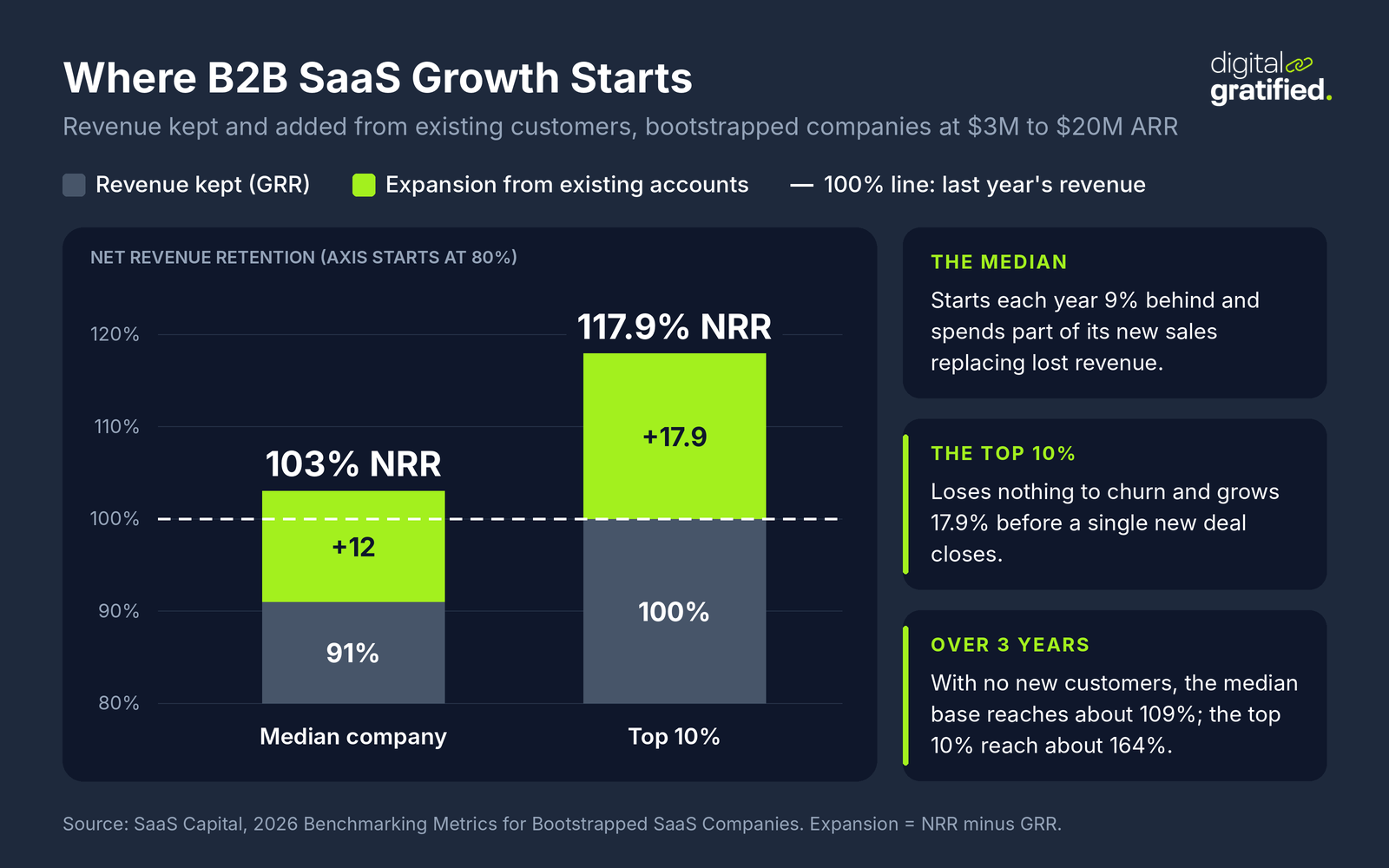
The lesson for a founder is where the gap comes from. The difference between a median company and a top-decile one is not how many deals it closes; it is what happens after the contract is signed: onboarding, adoption across the account, and a clear path to a bigger plan. Those are product and customer success decisions as much as sales ones, and they shape what marketing should promise in the first place.
How B2B SaaS Companies Sell: Contract Size Sets the Motion
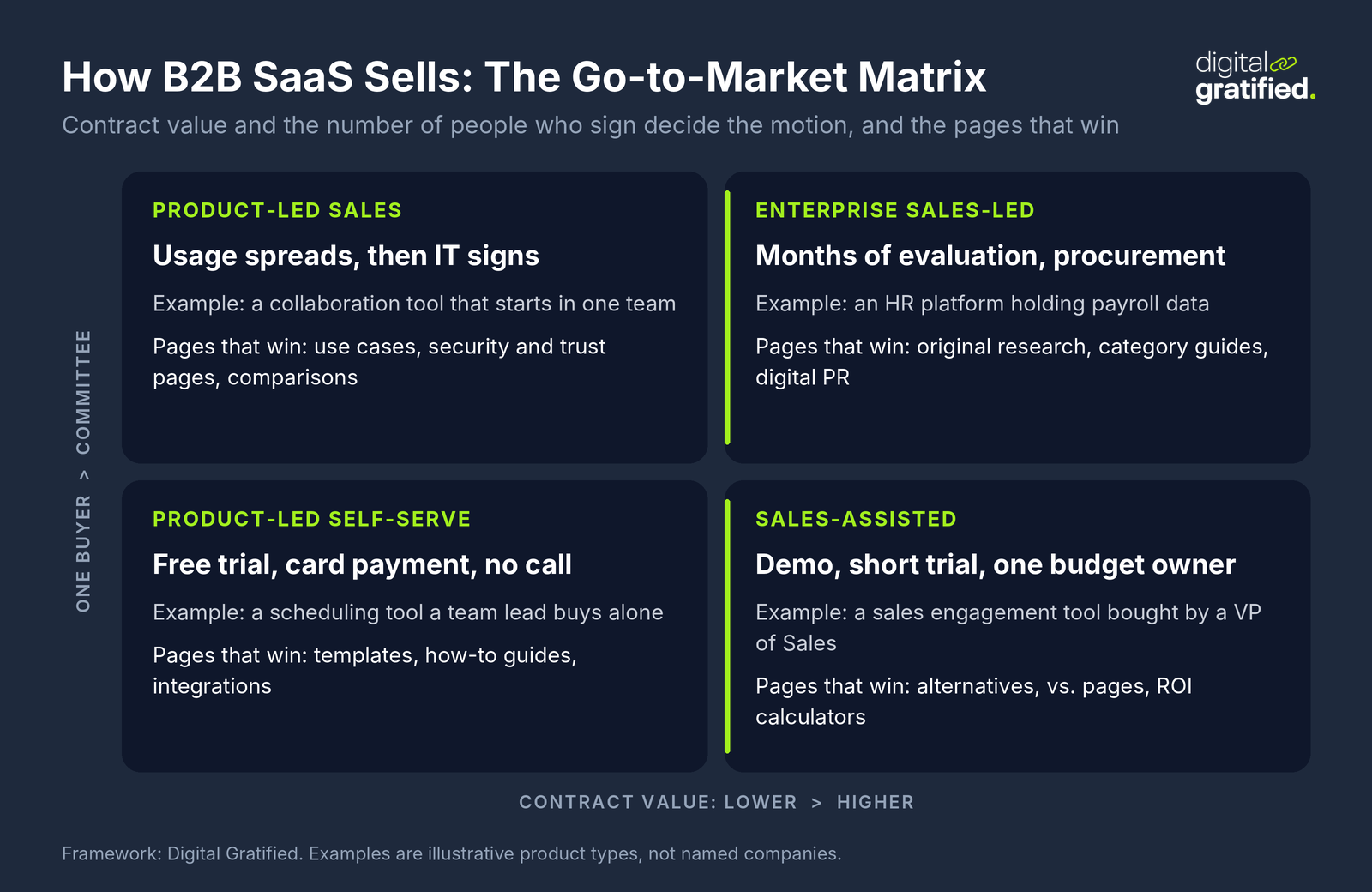
A B2B SaaS company cannot choose its sales motion freely. Two things decide it: how much a contract is worth and how many people have to agree before it is signed. A low-priced tool that one manager can buy on a company card can be sold through a free trial and a pricing page. A six-figure platform that touches payroll data needs a sales team, a security review and months of patient follow-up. Trying the wrong motion is one of the most expensive mistakes in SaaS: enterprise sales costs on a product priced for self-serve, or self-serve onboarding for a product that needs procurement sign-off.
Whatever the motion, B2B buyers now do most of the work before they talk to anyone. 6sense surveyed nearly 4,000 B2B buyers and found that buyers first contact a seller 61% of the way through their journey, that they pick a vendor from the four on their first-day shortlist 95% of the time, and that buying groups average more than ten people. The average cycle in that study ran 10.1 months.
For a B2B SaaS company, that last set of figures is the most important in this post. If you are not on the shortlist before the first sales call, you are very unlikely to win the deal. Search, review sites, peer recommendations and AI answers are where that shortlist gets built.
How AI Is Changing B2B SaaS Pricing
For two decades, most B2B SaaS was priced per seat: more users, more revenue. AI agents break that link, because an agent that resolves support tickets or drafts sales emails reduces the number of people who need a login. Buyers have noticed. G2 surveyed 1,019 B2B decision-makers in July 2026 and published the results on October 14: only 9% consider per-seat pricing the fairest model for AI agent services, while support for pay-as-you-go pricing rose sharply in a single year.
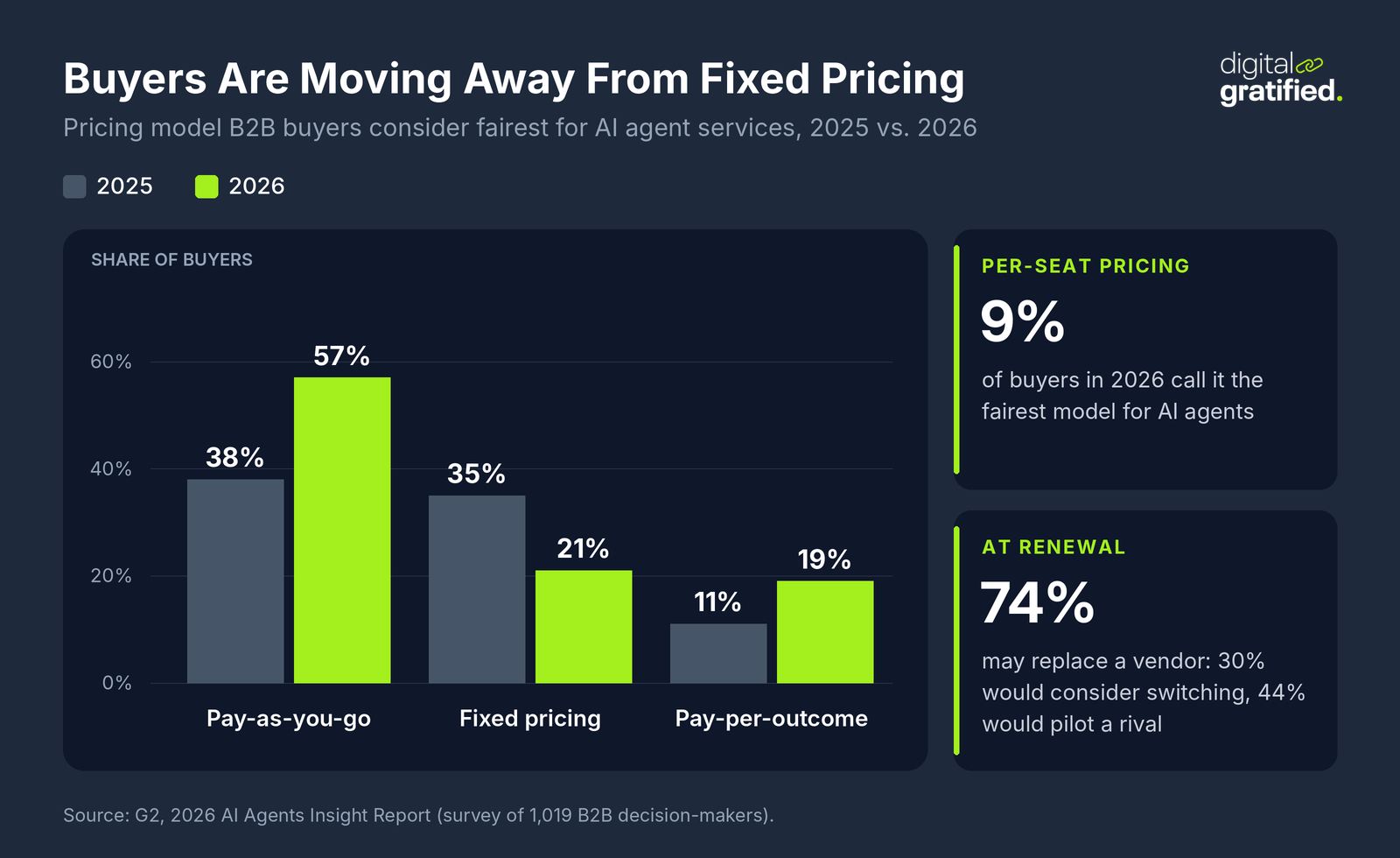
The same survey has a warning for anyone who thinks retention is safe: 30% of buyers would consider switching to a vendor with stronger agent capabilities, and another 44% would pilot an alternative and reconsider at renewal. Spending pressure points the same way. A SaaS management platform's analysis of $75 billion in spend found a median SaaS spend of $9,455 per employee, with 36% of licenses going unused. Unused seats are the first thing a finance team cuts at renewal.
Three practical consequences for B2B SaaS companies follow:
- Price on the value delivered, not only on logins. A hybrid model (a platform fee plus usage or outcome tiers) lets an AI feature earn more as it does more work, which is the direction buyers in the G2 data are moving.
- Prove adoption before the renewal conversation. Usage reporting, onboarding and customer success are now revenue defense, because every seat nobody uses is a line a finance team can cut.
- Expect more buyers to re-evaluate. When three in four buyers are open to testing an alternative, being findable at the moment they re-shop matters as much as being findable for first-time buyers.
What B2B SaaS Means for Marketing and SEO
The model sets the marketing rules. Because revenue depends on long contracts with groups of buyers who shortlist on their own, B2B SaaS marketing should be judged on the pipeline and ARR it creates, not on traffic. A blog post that brings 10,000 students a month is worth less to a payroll platform than a comparison page that brings 200 HR directors.
That has direct consequences for search. The pages that win B2B SaaS deals are the ones buyers use during the selection phase: alternatives and comparison pages, use case and integration pages, pricing explanations, and original research that analysts and journalists cite. We cover the full playbook in our guide to how B2B SEO changes when a committee does the buying, and the wider program in the full SaaS SEO program, from strategy to revenue.
Before you plan any of it, define your own model in five answers. We ask every new SaaS client these questions in the first week, because the answers decide which pages to build first:
- What is our ACV, and does it point to self-serve, sales-assisted or enterprise selling?
- Who is in the buying group, and what does each person search for before they agree to a demo?
- Are we horizontal or vertical, and which publications does our buyer trust?
- Where does growth come from today: new logos, or expansion inside existing accounts?
- Which page do buyers land on just before they request a demo or start a trial? That page needs the most authority.
With those answers, the rest becomes arithmetic. You can forecast organic pipeline before you invest, set budgets against what SaaS companies spend on marketing at each stage, and plan a SaaS content program organized by buying stage instead of by keyword volume. This is the work we do on SaaS SEO for B2B companies: technical audits, buyer-intent content and conversion-mapped keyword clusters, backed by editorial links from DR 50+ publications.
The marketing plan then has to match the company's stage. A pre-revenue founder and a Series C team face different constraints, and our guides to the growth levers that fit each SaaS stage and growing a bootstrapped SaaS business cover both ends. For the strategy that ties channels together, start with our guide to building B2B SaaS marketing moats. And if you are new to the category, the people and talks at the SEO and SaaS marketing events on this year's calendar are a fast way to learn how other teams run it.
Is B2B SaaS Still a Good Business Model?
Yes, with two caveats that matter more in 2026 than five years ago. The strengths are unchanged: predictable recurring revenue, high gross margins once the product is built, customers who rarely switch on a whim, and revenue that compounds when accounts expand. Businesses pay for software that saves time or makes money, and they pay every year.
The caveats are about growth and pricing. Growth across private SaaS is slowing, so a company can no longer count on a rising market to cover weak retention. And AI is changing both what customers expect to pay for and how easily they can replace a vendor. The B2B SaaS companies that do well from here will be the ones that measure themselves by NRR, price on the value their product delivers, and get onto the buyer's shortlist long before a salesperson is involved.
The Bottom Line
B2B SaaS is subscription software sold to businesses, but the useful definition is economic: it is a renewal business. Customers pay over time, so the company wins only if they stay and grow, and buyers decide most of that before they ever speak to sales.
So judge a B2B SaaS company, including your own, by net revenue retention and pipeline, not by signups or traffic. Work out your contract size and buying group first, then put your marketing where those buyers build their shortlist. If you want help building the search side of that, talk to us about SaaS SEO.
Frequently Asked Questions
What does B2B SaaS mean?
B2B SaaS stands for business-to-business software as a service: software that companies buy from another company as a subscription. The vendor hosts and maintains it, and customers use it through a browser or app for as long as they keep paying, usually monthly or annually.
What is an example of a B2B SaaS company?
Salesforce (CRM), HubSpot (marketing and sales), Slack (team messaging) and Zendesk (customer support) are classic horizontal examples that sell to any industry. Veeva (life sciences), Procore (construction) and Toast (restaurants) are vertical examples built for one industry.
What is the difference between B2B and B2C SaaS?
B2B SaaS is sold to organizations, often through a group of decision makers, at higher prices with longer sales cycles and contracts. B2C SaaS is sold to individuals at low, fixed prices, and the person who pays is usually the person who uses it. B2B companies also grow inside existing accounts through more seats, usage and upgrades.
How do B2B SaaS companies make money?
They charge recurring fees, priced per user, by usage, by tier or as a mix. Because customers pay over time, profit depends on retention: a company recovers the cost of winning a customer only if that customer renews, and grows fastest when existing accounts expand.
Is ChatGPT considered SaaS?
Yes. ChatGPT is cloud software paid for by subscription, which makes it SaaS. It is sold both to individuals, which is B2C, and to companies through business plans, which is B2B SaaS. Many AI products are also sold through usage-based APIs.
What is B2B SaaS sales?
B2B SaaS sales is the process of selling subscription software to businesses. Depending on contract size it runs through self-serve trials, inside sales teams that run demos for one budget owner, or enterprise sales that manage long evaluations with procurement, security and legal teams.
Is AI replacing SaaS?
AI is changing SaaS more than replacing it. Business buyers still pay for software, but AI agents reduce the number of users some tools need, so pricing is shifting from per-seat licenses toward usage and outcome-based models, and buyers are more willing to test alternatives at renewal.
About the author
Let's Scale Your SaaS Together
Get a custom SEO and link building strategy tailored for your SaaS business.
Get SEO insights that actually move rankings
Link building tactics, case studies, and SaaS SEO playbooks. No fluff, no spam.
You're subscribed!
SEO and link building insights, straight to your inbox.