B2B content marketing should put your product on the buyer's shortlist before sales gets involved. Here is how buyers use content now, a six-step strategy, the formats that fit each buying stage and how to measure content against pipeline.

Founder, Digital Gratified
B2B content marketing is publishing content that helps business buyers make a purchase decision, and it should be judged by the pipeline it creates, not the traffic it attracts. Most B2B companies run it backwards: they publish to fill a calendar, then wonder why a year of blog posts produced so few demo requests.
Our position is that B2B content has one job: getting your product onto the buyer's shortlist before anyone talks to sales. That means fewer pieces, built for every person in the buying group and for the AI tools they now research with, and measured against opportunities. This guide covers what B2B content marketing is, why most programs underperform, how buyers use content today, a six-step strategy, the formats that fit each buying stage, and what changes for a SaaS company.
What Is B2B Content Marketing?
B2B content marketing is the practice of creating and distributing useful content (articles, research, guides, comparison pages, webinars, newsletters and video) to attract and persuade buyers at other businesses. The content earns attention by answering questions buyers already have, and the company earns trust, leads and eventually revenue in return.
Two things separate it from simply running a blog. First, it is planned around a commercial goal: every piece should make a buying decision easier or move a known buyer closer to one. Second, it serves a group, not a person. A software purchase usually passes through a budget owner, the people who will use the tool, IT or security, and finance, and each of them reads different content before agreeing to a demo.
B2B vs. B2C Content Marketing
The craft is similar. The job is not, and copying a consumer playbook is one of the fastest ways to waste a B2B content budget.
| Factor | B2B content marketing | B2C content marketing |
|---|---|---|
| Who decides | A buying group, often with procurement, security and finance involved | One person, usually the user |
| Purchase cycle | Months, with most research done before sales contact | Minutes to days |
| What the content must do | Help a champion justify the choice to colleagues and reduce perceived risk | Spark interest and make buying easy |
| Formats that carry weight | Comparison pages, original research, case studies, technical documentation | Social posts, short video, reviews, product pages |
| How success is measured | Pipeline, demo and trial requests, revenue | Sales, sign-ups, repeat purchases |
The row to remember is the third. B2B content has to survive being forwarded. A finance director who never visited your site will read the comparison page your champion sends her, and that page has to answer her questions too.
Why Most B2B Content Marketing Underperforms
Almost every B2B company does content marketing, and most of it only partly works. In CMI's survey of 1,015 B2B marketers for its 2026 B2B content and marketing trends report, 59% rated their content marketing at least somewhat effective, but only 12% called it highly effective. The biggest problems they named were creating content that prompts a desired action (40%), resource constraints (39%) and measuring content effectiveness (33%).
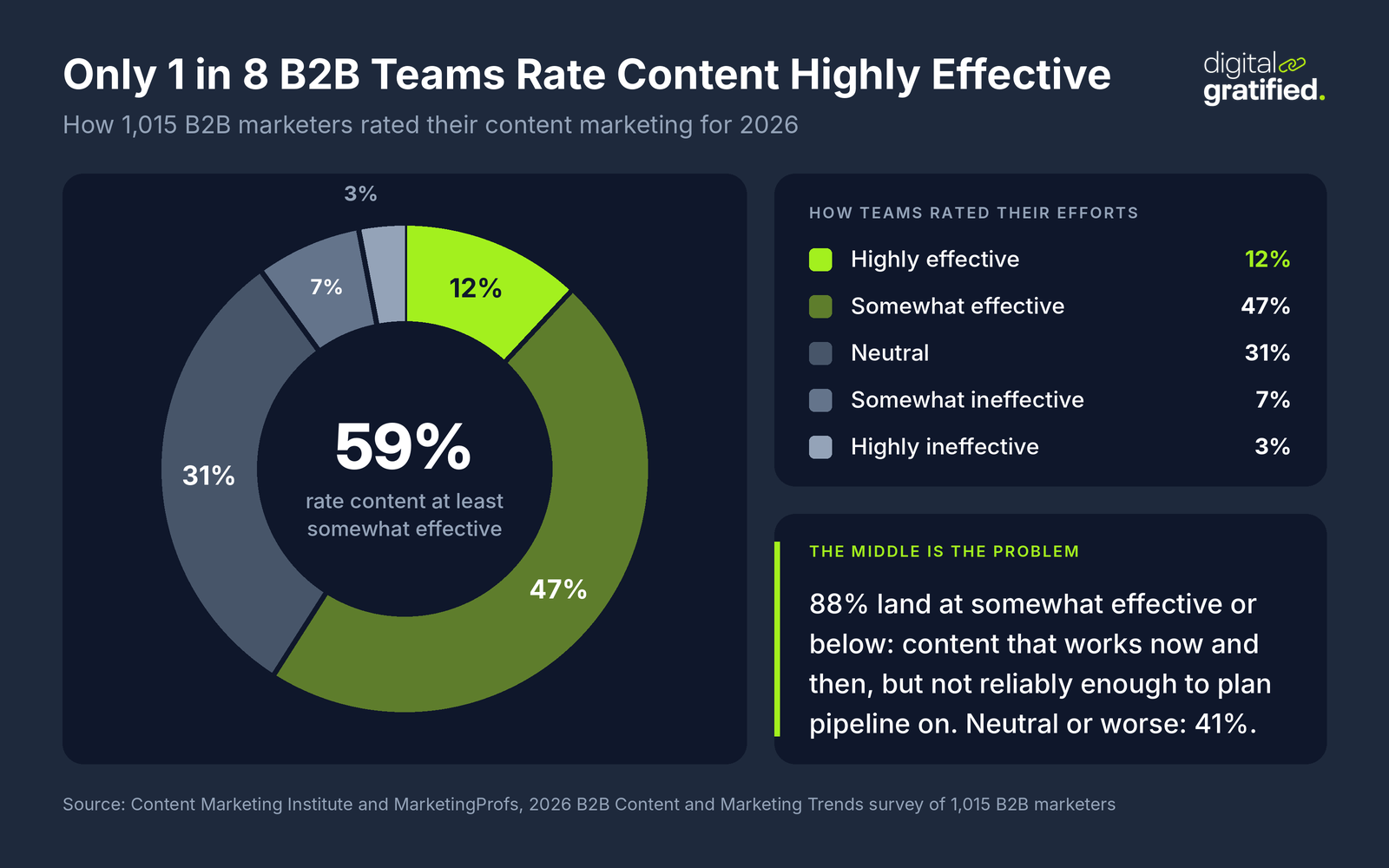
Read those three problems together and the pattern is plain. Teams publish content that never asks the reader to do anything, with too few people to produce it well, and with no way to tell which pieces lead to revenue. Publishing more fixes none of them. We find the same three causes when we audit SaaS blogs: dozens of top-of-funnel articles, no page built for buyers comparing vendors, and analytics that stop at page views. Our breakdown of the publishing habits that keep SaaS content from ranking goes deeper on the first cause.
AI has made the volume problem worse, not better. Nearly all B2B marketers (95%) now say their organization uses AI tools, and 89% use them to create content. Of those, 87% reported higher productivity, but only 58% said quality improved. Google's guidance on people-first content asks site owners whether they are "producing lots of content on many different topics in hopes that some of it might perform well in search results." If the truthful answer is yes, the fix is fewer, better pieces.
How B2B Buyers Use Content Now
The buying journey has moved further out of sales' reach. 6sense surveyed nearly 4,000 buyers for its 2025 B2B Buyer Experience Report: first contact with a seller came about 61% of the way through the journey, 94% of buyers had ranked their shortlist before engaging sellers, and they bought from a vendor on their day-one shortlist 95% of the time. And 94% of buyers used large language models somewhere in the process.
For software, AI tools are now often the first stop. In a March 2026 survey of 1,076 B2B decision-makers, 51% said they start software research in an AI chatbot more often than in Google, and 54% named AI chatbots as the top influence on their shortlist, ahead of software review sites at 43%.
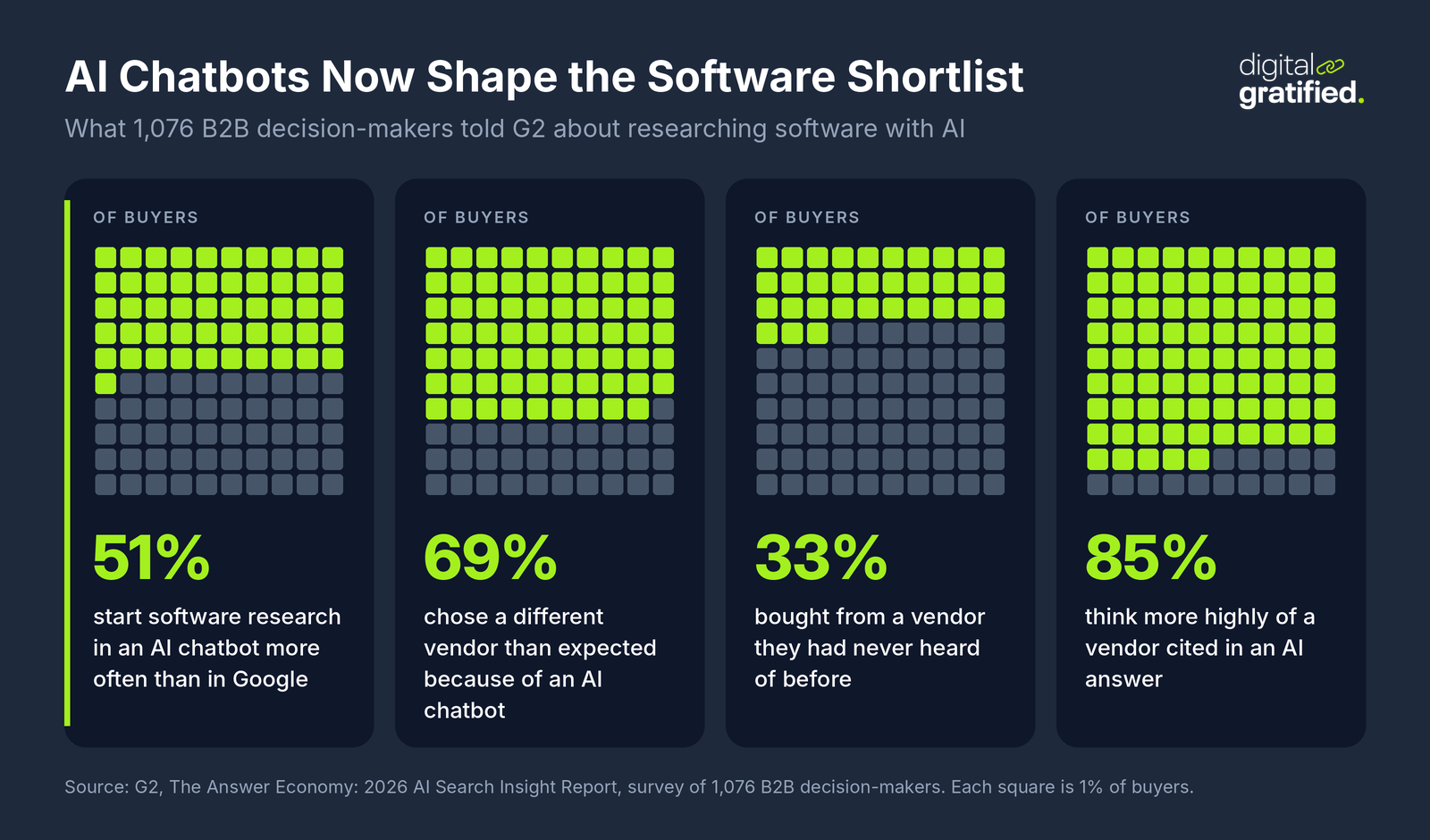
Two consequences follow for anyone planning B2B content. Content now does its most important work before you know the buyer exists, so a gated PDF that only counts once someone fills in a form misses most of its influence. And your content has to be easy for an AI system to read, quote and attribute, because an AI answer is now one of the places a shortlist gets written. Our guide to earning citations in AI answers as a SaaS brand covers the technical side; the strategy below covers what to publish.
How to Build a B2B Content Marketing Strategy in Six Steps
This is the framework we use with SaaS clients. It starts from revenue and works back to topics, which is the opposite of starting from a keyword list.
Step 1: Start From the Deals You Won
Pull your last 10 to 20 closed-won deals and your last 10 lost ones. For each, find out what the buyer searched for, which competitors they compared, which objections came up and who signed. Sales call recordings, CRM notes and 20-minute interviews with two or three recent customers will give you this in a week. The output is a list of real buying questions in the buyer's own words. That list beats any keyword tool as a topic source, because it tells you which questions sit next to money.
Step 2: Map Content to the Buying Group, Not a Persona
A persona describes one imagined buyer. A buying group has several real ones with different questions. For each role that appeared in step 1, write down what that person must believe before the deal can move: the user needs to see the workflow, the budget owner needs the business case, IT needs security and integration answers, and finance needs pricing and payback. Each belief becomes a content need. Most SaaS sites cover the user and ignore the other three, which is why deals stall in procurement after the demo went well.
Step 3: Build the Decision Pages First
Before you write another top-of-funnel article, build the pages buyers read while choosing: comparisons against named competitors, alternatives pages, pricing explanations, integration pages and use case pages. They target searches with low volume and high intent, and they are the pages an AI answer draws on when a buyer asks which tool fits a specific need. Our guide to B2B SEO built around buying-stage pages explains how to find and prioritize them, and our post on scoping topical authority to the product you sell shows how to group them into clusters that rank together.
Step 4: Publish One Asset Others Cite
Every B2B content program needs at least one asset other people reference: an original data study, a benchmark, a survey, or a definitive guide built on information nobody else has. Google's guidance asks whether content provides "original information, reporting, research, or analysis", and original data is also what journalists, analysts and AI answers cite. One strong study can earn links and mentions for years. When we analyzed the backlink profiles of 420 SaaS websites, the point was to publish findings other writers could quote. This is the work our Authority Content team does for SaaS companies: data studies journalists cite, definitive long-form guides, and optimization for AI search.
Step 5: Distribute Where Buyers Already Are
Publishing is half the job. For thought leadership, B2B marketers rely most on LinkedIn (76%), email newsletters (54%) and speaking events or webinars (52%). For a SaaS company the practical version is simple: turn each major piece into a short sequence of LinkedIn posts from the founder or subject expert, a section in your newsletter, and a talking point sales can use on calls. Draftly is one tool for drafting and scheduling those LinkedIn posts; general social schedulers such as Buffer or Hootsuite work if LinkedIn is one channel among several. Earned distribution matters as much as owned: a study cited in trade publications also builds the links and brand mentions that help your decision pages rank.
Step 6: Measure Content Against Pipeline
Measure each piece by the job it was given. Early-stage content earns visibility and returning visitors, decision pages earn demo and trial requests, and research earns links, mentions and citations. Then tie all of it to the CRM: record the first and last content page each opportunity touched, add a "how did you hear about us" field that sales completes, and report content-sourced and content-influenced pipeline as separate numbers. Our guide to a content ROI model that avoids fake precision covers the attribution choices, and the five SEO KPIs that roll up to pipeline sets out the scorecard for the search side.
B2B Content Types by Buying Stage
The best B2B format depends on where the buyer is. This is how we map formats to stages for SaaS clients, with the measure that tells you whether each piece is working:
| Stage | The buyer's question | Formats that fit | What to measure |
|---|---|---|---|
| Problem aware | "Is this problem worth fixing now?" | Original research, benchmark reports, explainer guides, podcasts | Returning visitors, newsletter sign-ups, citations |
| Exploring solutions | "How do companies like ours solve this?" | How-to guides, templates, webinars, use case pages | Engaged sessions on use case pages, assisted conversions |
| Comparing vendors | "Which tools fit us, and how do they differ?" | Comparison and alternatives pages, review site profiles, case studies | Demo and trial requests, AI citations on buyer prompts |
| Justifying the choice | "Can I defend this decision internally?" | ROI calculators, pricing pages, security and integration documentation, customer stories | Win rate, sales cycle length |
| Expanding | "What else can we do with it?" | Product education, release notes, customer webinars | Feature adoption, expansion revenue |
Two patterns show up when we audit SaaS content against this table. The first two rows are crowded and the comparing row is empty, so buyers who are weighing vendors land on a competitor's page instead. And the justifying row is treated as sales collateral hidden in a shared drive, when publishing it lets a champion forward a link instead of an attachment.
What a Shortlist-Ready B2B Page Looks Like
The comparison page is where most B2B SaaS content programs win or lose, so it deserves more design effort than any blog post. The strongest ones read like an analyst briefing rather than a sales page: they say who each option suits, show evidence, and give every member of the buying group a reason to keep reading.
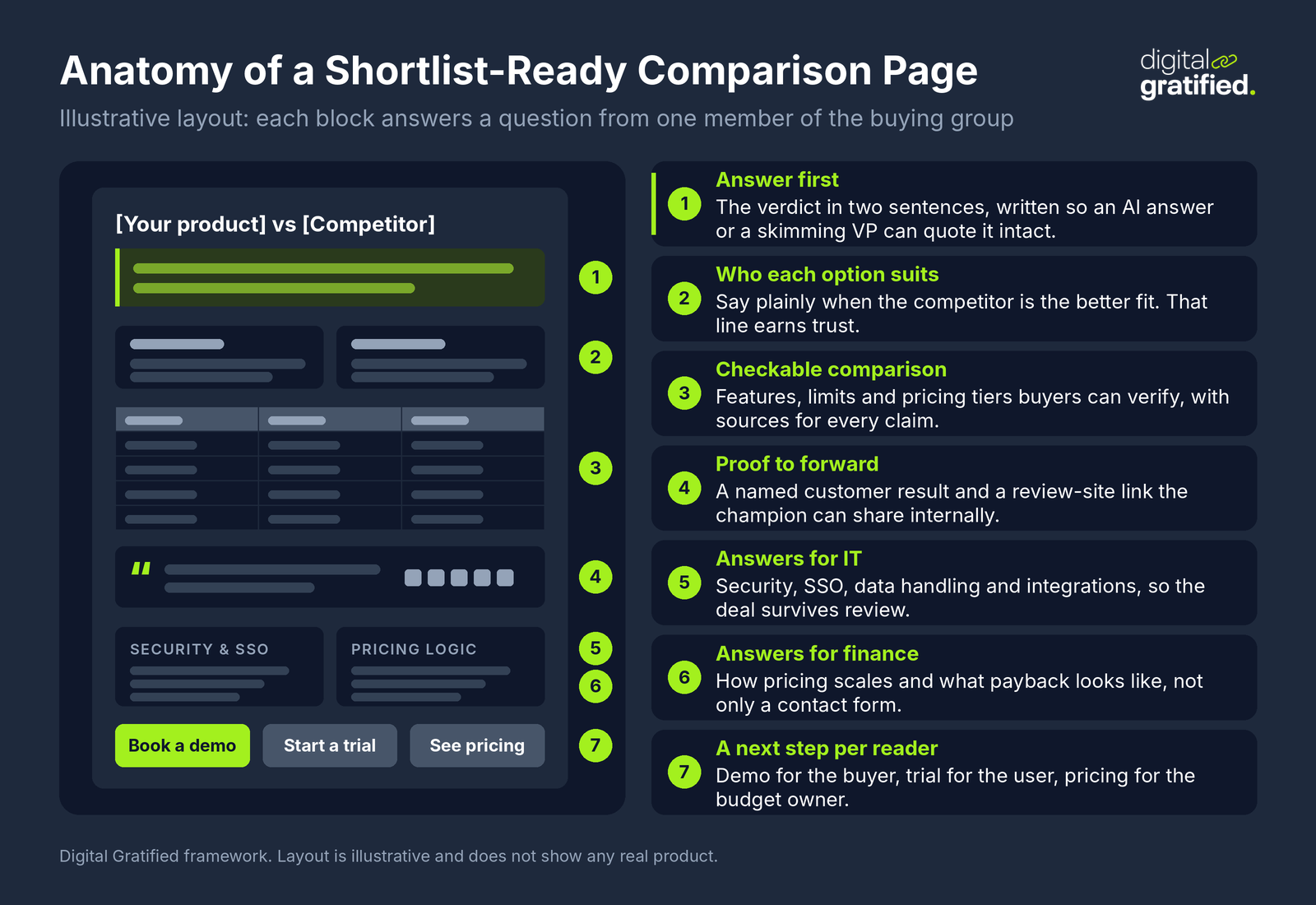
Notice what is missing from that layout: no gated download, no claim without evidence, and no pretense that your product suits everyone. Buyers trust a page that tells them when a competitor is the better fit, and so do the editors and AI systems deciding whether to cite it. The opening verdict matters most, because it is the passage most likely to be lifted into an AI answer intact.
B2B SaaS Content Marketing: What Changes for Software Companies
Software companies face three conditions that general B2B guides skip.
Your Sales Motion Sets the Content Mix
A product-led company with a free trial needs content that gets a visitor to sign up and reach the first useful action: templates, short tutorials and use case pages that end inside the product. A sales-led company selling six-figure contracts needs content for a long evaluation: research that puts the problem on a committee's agenda, security and integration documentation, and business cases. Enterprise SaaS content marketing leans hardest on the justifying stage, because a deal can die in procurement after the users have already said yes. If contract value and sales motion are new concepts for your team, start with how contract size shapes the way B2B SaaS sells.
Your Product Is a Content Source
A SaaS product generates information nobody else has: aggregated usage patterns, benchmarks across your customer base, and integration behavior across thousands of accounts. Publishing anonymized, privacy-safe findings from that data is the cheapest route to original research, and competitors cannot copy it because they do not have your data.
AI Search Rewards Clear Sources
Google keeps changing how AI answers link out. On October 15, 2026, it added more inline links to AI Mode and AI Overviews and moved some links higher in responses, but it still would not commit to sharing click data for those links. For a SaaS content team that means two things: write pages that state a clear, quotable answer early so they qualify as the source, and track AI visibility by sampling citations on a fixed set of buyer prompts each month rather than waiting for click reports.
How Much B2B Content Should You Publish? A 12-Month Example
Less than most teams plan. Here is how we would phase the first year for a Series A SaaS company with one content marketer and one freelance writer, producing about four substantial pieces a month:
- Months 1 to 3: 10 to 12 decision pages (comparisons, alternatives, pricing, top integrations) built from the buying questions found in step 1.
- Months 4 to 6: one original data study, four to six supporting articles that cite it, and a distribution sequence for each.
- Months 7 to 9: use case and justifying content for the roles that stall deals, usually security, IT and finance.
- Months 10 to 12: refresh the decision pages with new data and customer proof, and scope the next study.
That is roughly 45 to 50 pieces in a year, and every one has a buyer, a stage and a measure attached. Expect search results to lag: on our SaaS SEO campaigns, measurable shifts in rankings and traffic typically appear between months 3 and 6, and pipeline follows a sales cycle later. For the full planning process, see our step-by-step content plan for SaaS teams, and for how content works alongside paid, product and sales, read where content sits in a wider B2B SaaS marketing strategy.
The Bottom Line
B2B content marketing works when every piece has a buyer, a stage and a measure. Buyers now settle most of their shortlist before talking to sales, often with an AI tool open, so the content that matters is the content that puts you on that list: decision pages, research others cite, and proof a champion can use to persuade the rest of the buying group.
So cut the calendar back to what your buyers need, build the comparison and justifying pages first, publish one study worth citing, and report content against pipeline. If you want a team to build that research and those guides with you, talk to us about Authority Content.
Frequently Asked Questions
What is B2B content marketing?
B2B content marketing is creating and distributing useful content, such as research, guides, comparison pages, webinars and newsletters, to attract and persuade buyers at other businesses. It is planned around a commercial goal and judged by the pipeline and revenue it helps create, not by traffic alone.
Why is content marketing important for B2B companies?
B2B buyers do most of their research before they speak to a seller, and they usually buy from a vendor already on their first shortlist. Content is how a company gets onto that shortlist, and how a champion inside the buyer's company justifies the choice to colleagues.
What is the difference between B2B and B2C content marketing?
B2B content is written for a buying group with long purchase cycles, so it has to reduce risk and help a champion persuade colleagues in IT, finance and procurement. B2C content usually targets one person making a quick decision, so it focuses on interest and ease of buying.
What types of content work best for B2B?
It depends on the buying stage. Original research and explainer guides work early, how-to guides and use case pages help buyers explore solutions, comparison and alternatives pages win vendor evaluations, and pricing, security and ROI content helps buyers justify the decision internally.
What is a B2B content marketing funnel?
A B2B content marketing funnel maps content to the stages a buyer moves through: recognizing a problem, exploring solutions, comparing vendors, justifying the choice and expanding use after purchase. Each stage needs different formats and a different measure of success.
How do you measure B2B content marketing?
Give each piece a job and measure that job: visibility and returning visitors for early content, demo and trial requests for decision pages, and links, mentions and citations for research. Then connect content to your CRM and report content-sourced and content-influenced pipeline separately.
How is B2B SaaS content marketing different?
SaaS companies match content to their sales motion: product-led companies need content that drives sign-ups and first use, while sales-led companies need research, security documentation and business cases for long evaluations. SaaS products also produce usage data that can become original research competitors cannot copy.
About the author
Let's Scale Your SaaS Together
Get a custom SEO and link building strategy tailored for your SaaS business.
Get SEO insights that actually move rankings
Link building tactics, case studies, and SaaS SEO playbooks. No fluff, no spam.
You're subscribed!
SEO and link building insights, straight to your inbox.