Topical authority is focus Google can see. Here is what Google has confirmed about it, a worked topical map for a SaaS category, the build order we use, and how to measure it in pipeline.

Founder, Digital Gratified
Topical authority is the trust a search engine places in your site for one subject, earned by covering that subject in depth, connecting the pages well and getting cited by other sites in the same field. For a B2B SaaS company, the useful version is narrower than most guides suggest: own the topic your product solves, end to end, with the comparison and product pages inside the cluster, rather than publishing a hundred loosely related blog posts.
This guide covers what topical authority is, what Google has and has not confirmed about it, why it matters more for SaaS than for publishers, a worked topical map for a real software category, the build order we use, and how to measure it in pipeline rather than in rankings alone.
What Is Topical Authority?
Topical authority describes how strongly a search engine associates your site with a subject and how much it trusts you on it. A site with it ranks new pages on that subject faster, ranks for long-tail questions it never targeted directly, and holds its positions through updates better than a site that wanders across topics.
It is not a score Google publishes or a number any SEO tool can read from Google. Tools that show a "topical authority" figure are estimating it from their own data. Treat it as a description of an outcome: the result of depth, structure, focus and relevant links working together.
Three terms get mixed up constantly, and the difference matters for where you spend money:
| Term | What it describes | How you build it | What it tells a SaaS team |
|---|---|---|---|
| Topical authority | Trust in your site for one subject | Depth of coverage, internal links, focus, links and mentions from sites in the same field | Whether new pages on your core topic can rank without a fight |
| Domain authority (or Domain Rating) | A third-party estimate of the strength of your whole backlink profile | Links from any site, on any subject | How much raw link strength you have, regardless of topic |
| Topical relevance | How closely one page, or one linking site, matches a subject | Writing and linking on topic, page by page | Whether a single page or a single backlink fits the cluster |
The practical consequence: a focused vertical SaaS site that covers expense policy, receipts, reimbursement and approvals in depth can outrank a far stronger generalist on expense questions. Domain strength still helps, but it does not substitute for coverage.
Does Google Measure Topical Authority?
Google has never published a "topical authority" ranking factor for websites in general. What it has done is describe several systems that move in the same direction, and the pattern is consistent enough to plan around.
The closest official statement is Google's explanation of its news topic authority system in May 2023. It applies to news queries, and it looks at how notable a publication is for a topic or location, how original and influential its reporting is (judged partly by links and citations), and its reputation. Google's Search Liaison added that the system had been in use for several years before the announcement. It is not a SaaS signal, but it shows how Google thinks about expertise on a subject: focus, original contribution and recognition from others.
For everyone else, the clearest hint sits in Google's guidance on creating helpful content. Its self-assessment questions include "Does your site have a primary purpose or focus?" and warn against "producing lots of content on many different topics in hopes that some of it might perform well in search results." That system was folded into Google's core ranking systems in March 2024, so site focus is no longer a separate update you can wait out.
The 2024 leak of Google's internal API documentation added two attribute names that SEOs now cite constantly: siteFocusScore, described as how much a site is focused on a specific topic, and siteRadius, how far page embeddings deviate from the site embedding. Read that with care. The documents list attributes; they do not show weights or whether a given attribute is used in ranking. What they do confirm is that Google can represent a whole site as a topic and measure each page's distance from it, which is exactly the problem with a SaaS blog that drifts into general marketing advice.
The timeline below shows how these pieces arrived. Each step moved Google further from matching words and closer to judging what a site is about.
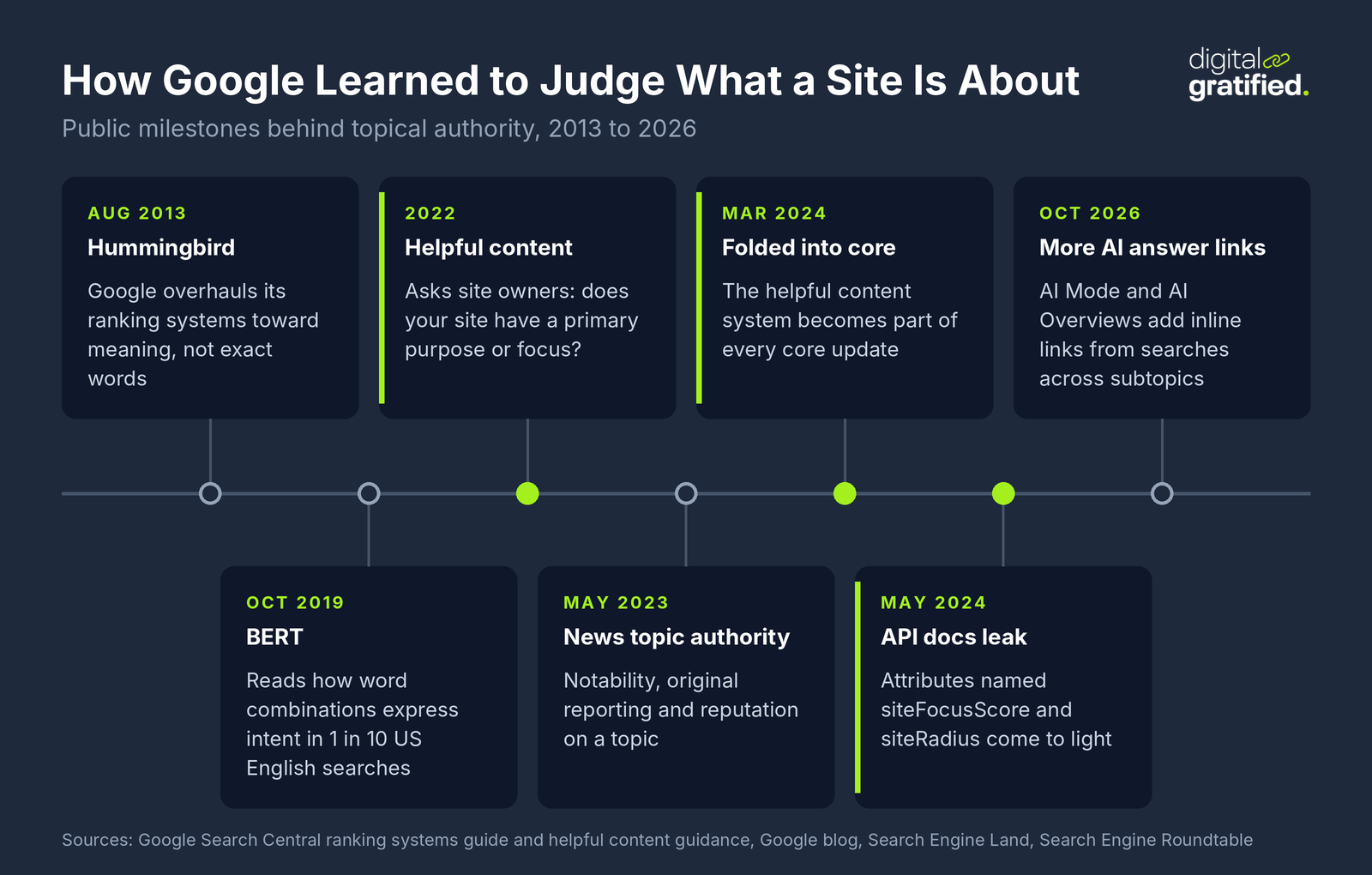
Our read of that history: Google does not need a single topical authority score to reward focus. Language understanding (Hummingbird in 2013, BERT in 2019, which Google said would affect one in 10 US English searches) lets it group pages by meaning, and site-level quality systems then decide how much a focused site deserves the benefit of the doubt.
Why Topical Authority Matters More for SaaS Than for Publishers
A publisher can win on volume. A SaaS company rarely can: its content team is small, and the pages that matter commercially (alternatives, comparisons, use cases, the product category page) sit on some of the most contested results in search. Topical authority is how a smaller site gets those pages to rank without outspending incumbents on links.
The Commercial Head Term Is the Hard Part
Take expense management software as an example. In Ahrefs' US data, "expense management software" has 3,700 monthly searches and a keyword difficulty of 39, and "corporate card" sits at KD 48. Around them is a wide ring of supporting searches with almost no competition: "expense report template" (3,800 searches, KD 0), "expense policy" (450, KD 2), "travel expense policy" (250, KD 4) and "reimbursement policy" (200, KD 0). The buying-stage terms are often easy too: "expensify alternatives" has 700 searches at KD 0 and "ramp vs brex" 1,100 at KD 5.
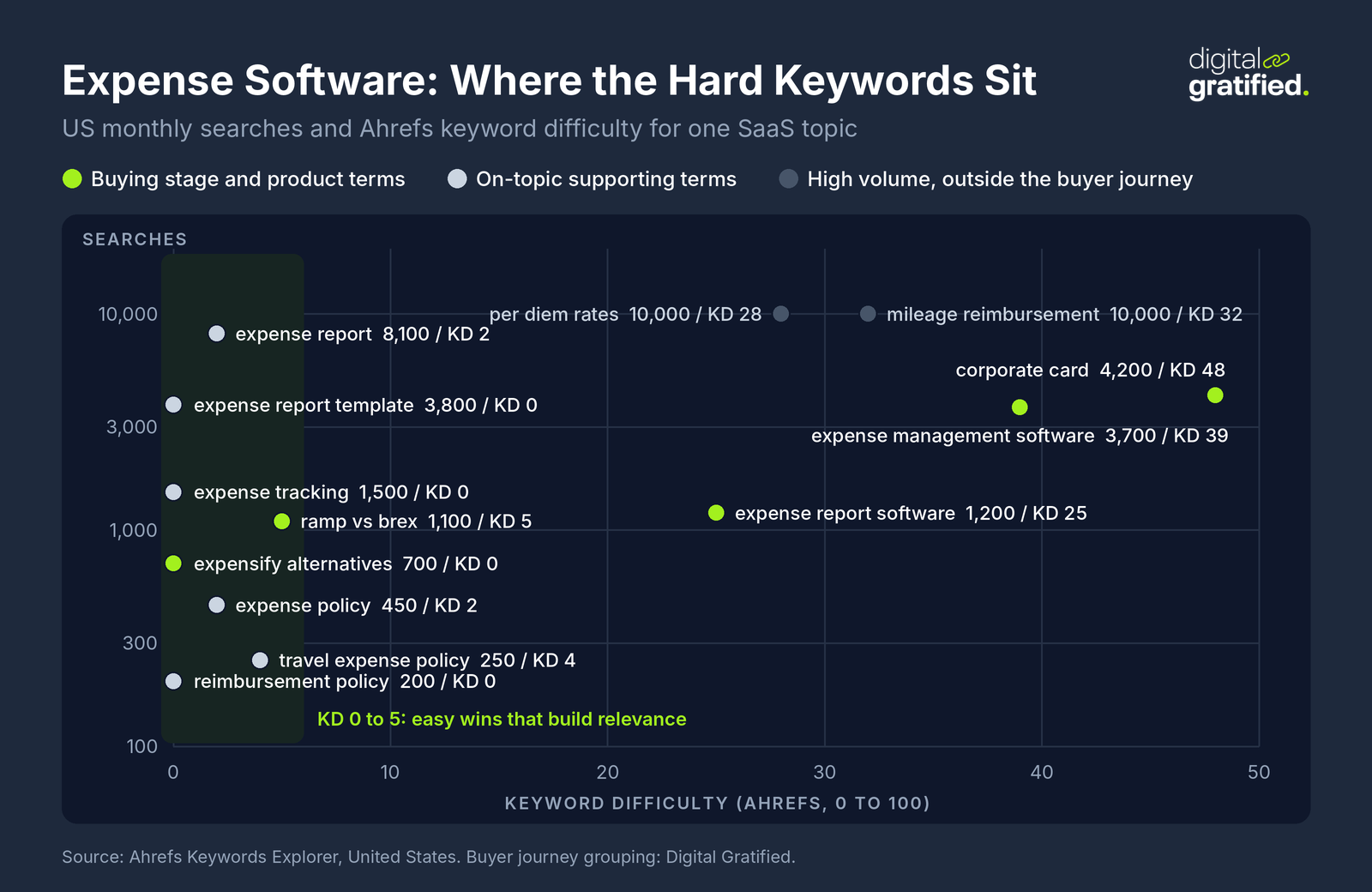
That shape is typical of B2B software. The supporting topics are cheap to rank for, and covering them well is what convinces Google that a site deserves to rank for the expensive category term. The chart also shows the trap: "per diem rates" and "mileage reimbursement" each draw 10,000 searches, but the pages ranking for them are answering questions about government rates, not software. They sit inside the subject on paper and outside the buyer's journey in practice, so we would cover them briefly, if at all.
AI Answers Search Across Subtopics
AI search makes coverage matter more, not less. Google says AI Overviews and AI Mode may use query fan-out, "issuing multiple related searches across subtopics and data sources" to build a response. A buyer who asks how to pick expense software for a 200-person company sets off searches on approval workflows, card controls, policy enforcement and integrations. A site that has a strong page for each of those subtopics has several chances to be cited; a site with one category page has one.
The links inside those answers are also getting more prominent. On October 15, 2026, Google added more inline links in AI Mode and AI Overviews and a section at the top of some responses that highlights the one or two links needed to complete a task. Being the obvious source for a narrow subtopic is how you become one of those links. Our guide to how AI answers choose which SaaS brands to cite covers the rest of that work.
How to Build Topical Authority for a SaaS Site
This is the order we use. It differs from the usual advice in one important way: the commercial pages are built first and treated as part of the cluster, not as something marketing adds after the blog takes off.
1. Scope the Topic to What Your Product Solves
Most SaaS topical maps fail at this step because they are too wide. "Finance" is not a topic an expense tool can own; "employee spend, from policy to reimbursement" is. A good scope passes three tests: your product is a credible answer to most of the questions inside it, your sales team hears those questions on calls, and a first-time visitor reading five random pages would know what you sell.
Write the scope as one sentence and use it to say no. Everything you publish should sit inside it or link clearly into it.
2. Map the Topic in Buying Stages, Not Keyword Lists
Keyword tools group terms by wording. Buyers move through problems, solutions, shortlists and decisions. Build the map around the second, then fill it with keywords. Here is a worked topical map for a hypothetical expense management company:
| Layer | Example pages | Job in the cluster | Links to |
|---|---|---|---|
| Hub | Expense management: the complete guide | Defines the topic and routes readers to every subtopic | All layers below |
| Problem | Expense policy template, travel expense policy, reimbursement policy | Earns rankings and links on low competition questions | Hub, plus the solution page that fixes the problem |
| Solution | How to automate expense reports, receipt matching explained | Shows the method your product uses, without a hard sell | Hub, category page, a use case page |
| Shortlist | Expensify alternatives, Ramp vs Brex | Captures buyers comparing vendors | Category page, pricing, demo |
| Product | Expense management software category page, use case pages | Converts, and receives authority from the whole cluster | Pricing, demo, integrations |
A cluster like this usually needs 15 to 40 pages, not 200. If your map is much bigger, the scope is probably too wide or you are splitting one search intent across several pages.
3. Build the Commercial Pages First
Our position, and it runs against most topical authority advice: publish the shortlist and product layers before the long tail. They are the pages that create pipeline; alternatives and comparison terms are often low difficulty (as the expense data shows), and every supporting article you publish later has somewhere useful to send its readers and its authority. We made the same case in our guide to building B2B pages in buying order.
Then add the problem and solution layers in batches of five to ten pages around one subtopic at a time. A finished subtopic beats ten half-started ones, because Google and buyers both judge depth subtopic by subtopic.
4. Connect the Cluster With Internal Links
Internal links are how you tell Google which pages belong together and which page is the main one. Every page links up to the hub, the hub links down to every page, sibling pages link to each other where a reader would want the next answer, and every educational page links to the commercial page that solves the problem it describes. Google's AI features guidance repeats the basics here: content should be easy to find through internal links.
The difference shows clearly when you draw a typical SaaS blog before and after this work:
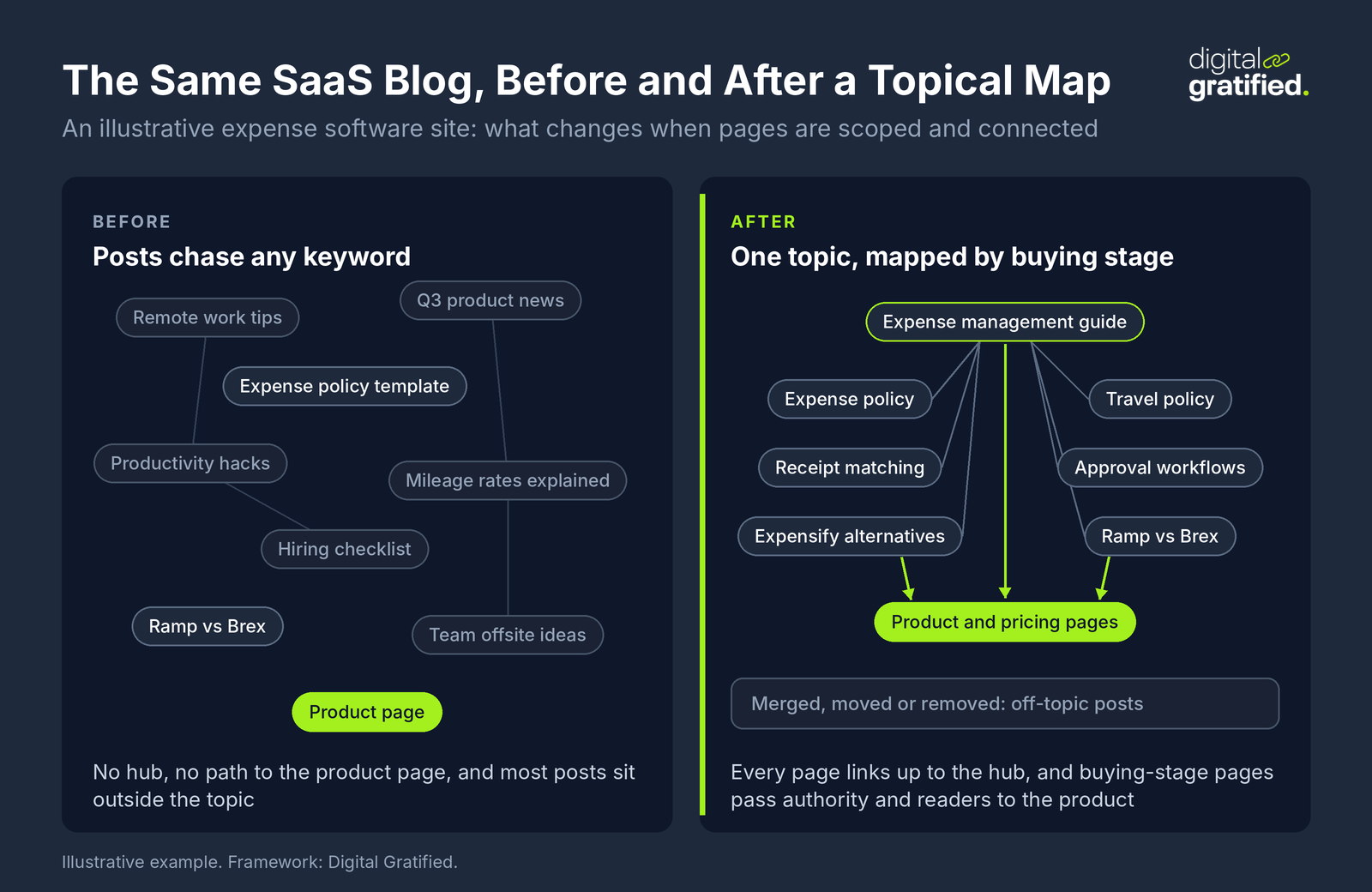
Our guide to hub and spoke internal linking for SaaS sites covers anchors, link placement and how to audit an existing site.
5. Earn Links From Sites in the Same Field
Coverage gets you considered; links from relevant sites get you trusted. Google's news system looks at citations from others as a sign of influence, and the same logic shows up in link analysis everywhere: a link from a finance operations newsletter does more for an expense tool's topical standing than a link from a general business site with twice the authority score. If you need a refresher on why, our primer on how backlinks and referring domains work covers the mechanics.
Point outreach at the hub and at original resources (data, templates, calculators) inside the cluster, then let internal links carry that authority to the commercial pages. This is the combination we run in our Authority Content work for SaaS clients: data studies journalists cite, long-form guides built around buyer-intent keyword clusters, and optimization for AI search, backed by editorial links from B2B and SaaS-relevant publications with DR 50 or higher.
6. Prune, Merge or Move Off-Topic Content
If siteRadius means what its name suggests, every page far from your core topic pulls the site's center of gravity away from it. Many SaaS blogs carry dozens of posts on remote work tips, generic productivity or industry news that rank for nothing and confuse what the site is about.
Review them once a year. Merge thin posts that overlap into one stronger page and redirect the old URLs. Rewrite posts that sit near the topic so they tie back to it. Remove, or move to a separate section that you do not link from the cluster, anything that is neither on topic nor earning links or traffic. Keep any page that still has backlinks, and redirect it if you retire it. Our post on the reasons most SaaS articles never rank shows how off-topic publishing starts.
Topical Authority Mistakes We See on SaaS Sites
The same four errors account for most stalled programs:
- Chasing volume outside the buying journey. The per diem and mileage searches in the expense example would add 20,000 monthly searches to the map and almost no buyers. Traffic from the wrong audience also makes the site's focus less clear.
- Several pages for one intent. "What is expense management", "expense management definition" and "expense management meaning" are one page. Splitting them creates pages that compete with each other and makes the cluster look padded.
- Clusters with no commercial exit. A cluster that never links to a product, comparison or use case page builds authority for the blog, not for revenue.
- AI-generated filler at scale. Google's helpful content questions ask directly about "extensive automation to produce content on many topics." Coverage written without product knowledge or first-hand detail is the fastest way to look like a site that entered the topic without expertise.
How to Measure Topical Authority in Pipeline Terms
Because no tool can read Google's view directly, measure the outcomes it produces, at cluster level rather than page by page. Track these each quarter for every cluster:
- Coverage ranking: the share of the cluster's target keywords where you rank in the top 10. Rising coverage on terms you did not target directly is the clearest sign authority is building.
- Time to rank: how many weeks a new page in the cluster takes to reach page one. On a site with topical authority, this number falls with each batch.
- Cluster clicks and demo requests: organic clicks to the cluster from Search Console, and demo or trial requests from sessions that started on any page in it, from your CRM.
- Commercial page movement: the position of the category and comparison pages the cluster supports. This is the number the whole effort exists to move.
- AI citations: how often your pages are cited for a fixed set of buyer prompts in your category, checked by hand or with a tracking tool.
Report these per cluster, alongside pipeline, in the format we describe in our guide to cluster-level SEO reporting tied to revenue. And before you commit a quarter to a new cluster, forecast its pipeline from search demand so you know what success should look like by month six. Topical authority is a strategy, not a project with an end date: it sits inside the wider plan in our SaaS SEO guide on turning rankings into ARR, and its content side is covered step by step in our 10-step SaaS content plan.
The Bottom Line
Topical authority is focus that Google can see: depth on one subject, pages connected so the structure is obvious, and recognition from sites in the same field. For a SaaS company, the subject should be the problem your product solves, and the cluster should include the comparison and product pages from day one.
So narrow the scope before you write anything, build the commercial pages first, fill one subtopic at a time, and measure each cluster by the demos it produces. If you want a team to plan and build those clusters with you, start with our SaaS SEO and Authority Content services.
Frequently Asked Questions
What is topical authority in SEO?
Topical authority is the trust a search engine places in a site for one subject. It comes from covering that subject in depth, connecting the pages with internal links, keeping the site focused, and earning links and mentions from other sites in the same field. It is not a score Google publishes; tools that show one are estimating it.
How is topical authority different from domain authority?
Domain authority, or Domain Rating, is a third-party estimate of the strength of a site's whole backlink profile, whatever the subject of the links. Topical authority is about one subject: how completely you cover it and how relevant your links are. A focused site with modest domain strength can outrank a stronger generalist on its own topic.
How long does it take to build topical authority?
Plan in quarters, not weeks. A focused cluster on a site that already ranks for related terms can show movement within a few months; a new site or a contested category takes longer. The clearest early sign is that each new page in the cluster reaches page one faster than the last.
How many articles do you need for topical authority?
There is no fixed number. For a SaaS product, a well-scoped cluster usually needs 15 to 40 pages covering the problem, solution, comparison and product stages. If your map runs to hundreds of pages, the topic is probably too wide or you are splitting one search intent across several pages.
What is a topical map?
A topical map is the plan for a cluster: the hub page, every subtopic page, the keywords each one targets and how they link to each other. For SaaS, build it around buying stages (problem, solution, shortlist, product) rather than around keyword lists alone, so the cluster leads to pages that convert.
Does topical authority help in AI search?
Yes. Google says AI Overviews and AI Mode may run multiple related searches across subtopics to build an answer, so a site with a strong page for each subtopic has more chances to be cited. Google also says there are no special requirements for these features beyond standard SEO.
How do you measure topical authority?
Measure the outcomes at cluster level: the share of the cluster's keywords ranking in the top 10, how fast new pages in the cluster reach page one, organic clicks and demo requests from the cluster, the position of the commercial pages it supports, and how often your pages are cited for a fixed set of buyer prompts in AI answers.
About the author
Let's Scale Your SaaS Together
Get a custom SEO and link building strategy tailored for your SaaS business.
Get SEO insights that actually move rankings
Link building tactics, case studies, and SaaS SEO playbooks. No fluff, no spam.
You're subscribed!
SEO and link building insights, straight to your inbox.