Most SEO KPI lists track sixteen numbers. A SaaS team needs five that roll up to pipeline and ARR. Here is how to calculate each one, set targets backwards from revenue and read them now that AI answers absorb clicks.

Founder, Digital Gratified
SEO KPIs are the few numbers that tell you whether organic search is producing business results, and for a B2B SaaS company there should be five of them, not sixteen. Track buying-stage visibility, non-branded clicks to buying pages, demo and trial requests, organic-sourced pipeline and new ARR from organic; treat everything else (rankings, total traffic, Domain Rating, bounce rate) as a diagnostic that explains why those five moved.
This guide defines SEO KPIs, explains why the usual lists fail SaaS teams, sets out the five KPIs we use and how to calculate each one, shows how to set targets backwards from an ARR goal, and covers what changes now that AI answers sit on top of the results page.
What Are SEO KPIs?
An SEO KPI (key performance indicator) is a measurable target that shows whether your organic search program is reaching a business goal. The word that matters is "key". A KPI is something you set a target for, review on a schedule and change your plan over. If a number moving up or down would not change what you do next month, it is not a KPI.
Three terms get used as if they were the same, and mixing them up is how SEO reports grow to 40 slides:
- Metric: any number you can measure, such as impressions, average position or referring domains.
- KPI: a metric tied to a business goal, with a target, an owner and a review date.
- Diagnostic: a metric you check to explain why a KPI moved. It belongs in the appendix, not on the goal sheet.
Most SEO teams track the right metrics. The problem is that they promote diagnostics to KPIs, so the report celebrates a ranking gain in a month when demo requests fell.
Why Most SEO KPI Lists Fail SaaS Teams
The pages ranking for this topic list between 8 and 21 KPIs, and most of them stop at traffic, rankings and a generic ROI formula. For a SaaS company that sells on annual contracts, three problems follow.
Traffic Is Not the Outcome
A glossary post that brings 20,000 students a month can outgrow every commercial page on the site and add nothing to pipeline. Total organic sessions mix buyers with job seekers, students and existing customers logging in. A SaaS SEO program exists to put the product on buyers' shortlists, and B2B buyers build that shortlist early: in 6sense's survey of nearly 4,000 buyers, the winning vendor came from the buyer's day-one shortlist 95% of the time, and first contact with a seller happened 61% of the way through the journey. The KPI has to measure whether search put you on that list, not how many people read the blog.
Clicks Are Shrinking While Influence Is Not
Click-based KPIs now undercount search's effect. Across 300,000 keywords, an AI Overview correlates with a 58% lower average click-through rate for the top-ranking page. Tracked browsing data from 900 US adults shows the same pattern from the user side.
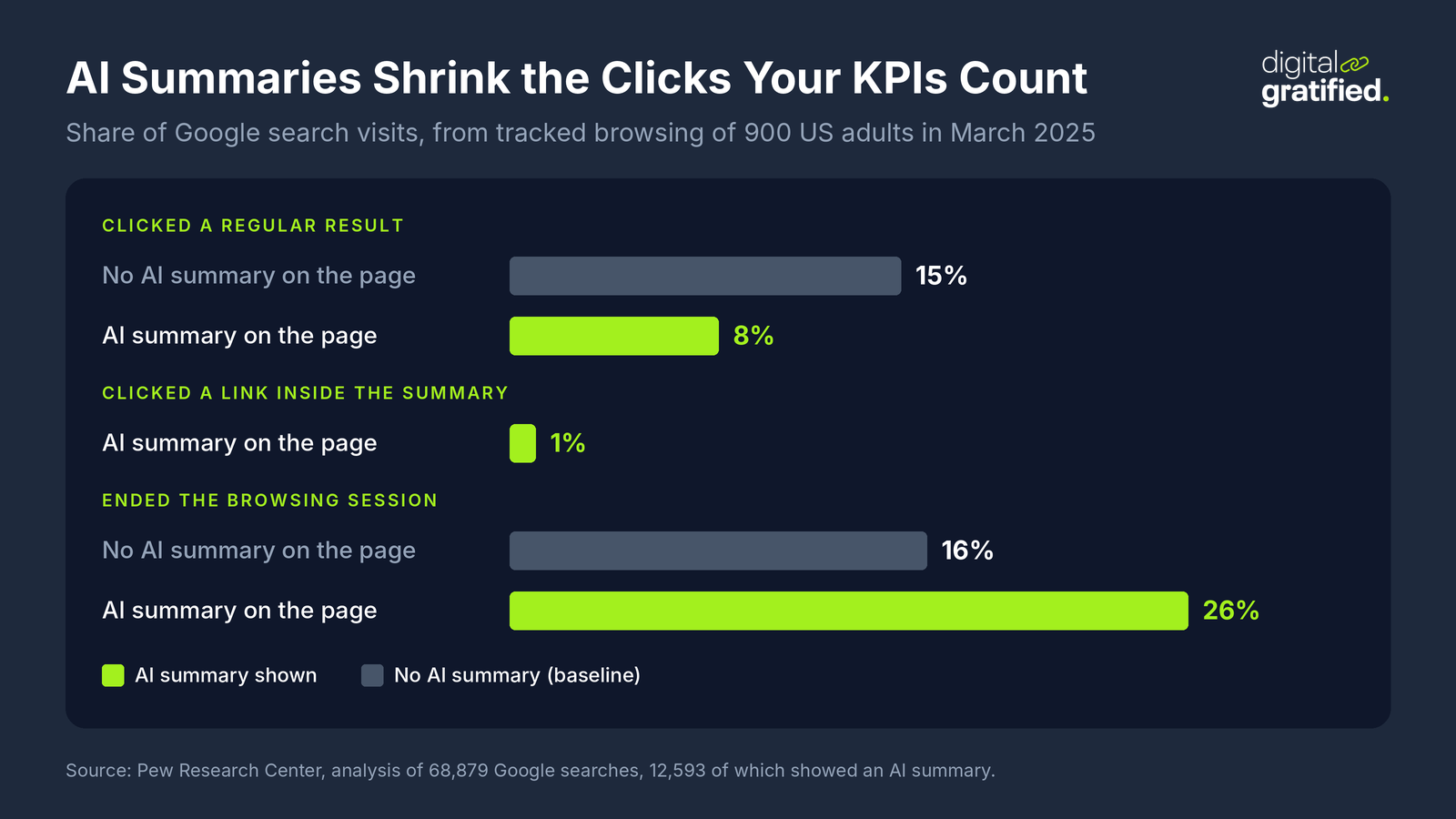
In that analysis of 68,879 searches, a summary on the page nearly halved clicks on regular results and made people more likely to stop searching altogether. A buyer who reads your brand name in an AI answer and later types it into Google shows up as a branded click, a direct visit or a demo request with no organic source at all. If your KPI is raw organic clicks, good work can look like decline.
Rankings Hide Which Pages Sell
Average position is a blended number. Google calculates it from the topmost position your link held for each query, averaged across all queries, and an AI Overview counts as a single position for every link inside it. Add 300 long-tail blog queries at position 40 and the site average drops, even if your pricing and comparison pages climbed. Rankings are worth tracking for a fixed set of buying-stage queries. As a site-wide KPI they mislead.
The 5 SEO KPIs That Matter for B2B SaaS
Our position: report five KPIs that form one chain, from the first signal Google gives you to the revenue sales closes. Each level feeds the next through a rate you can measure, so when a KPI stalls you know which rate to investigate.
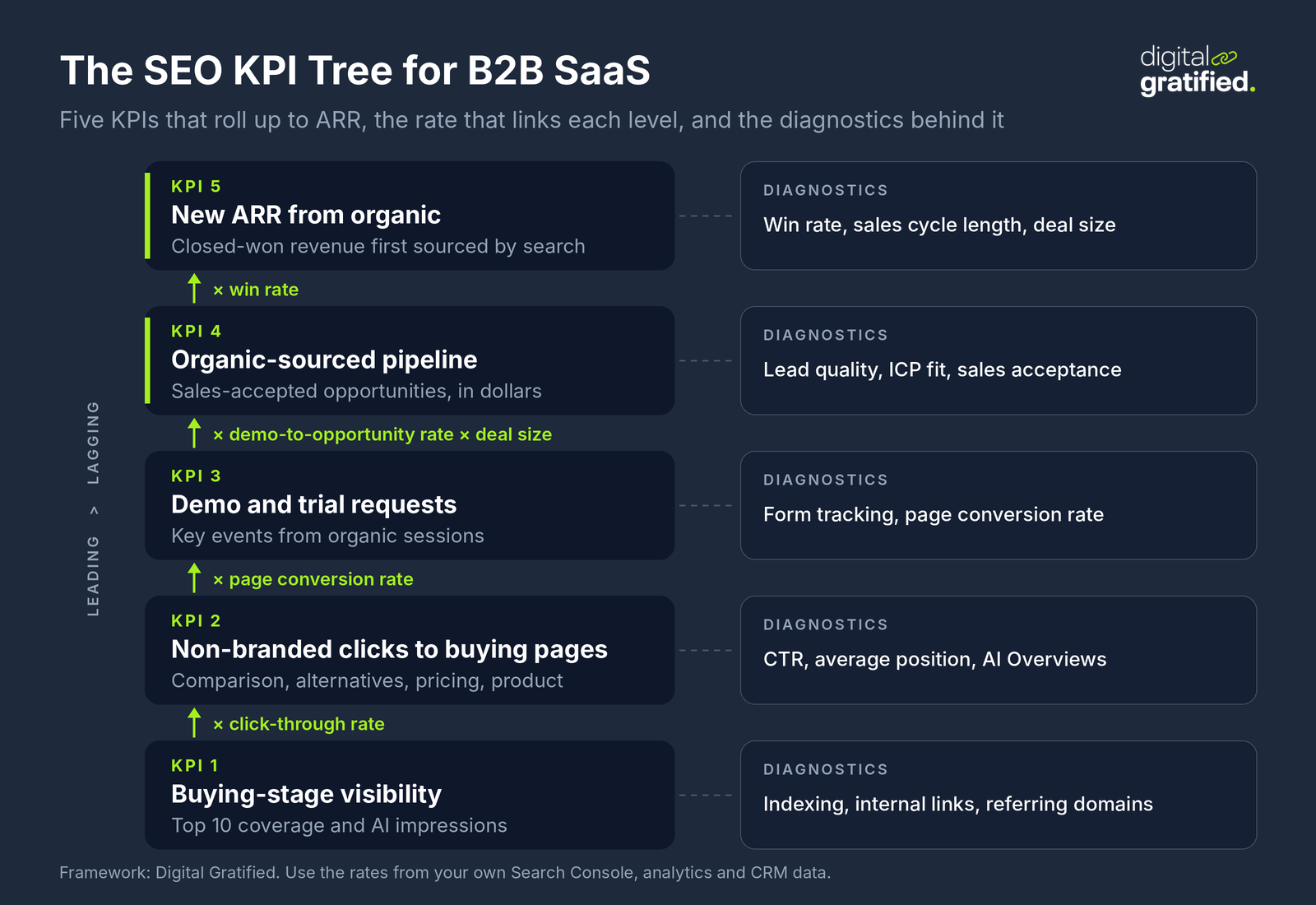
KPI 1: Buying-Stage Visibility
Pick a fixed set of 50 to 200 queries that buyers search while choosing software: category terms, "alternatives", "vs", "pricing", integration and use case queries. Track the share of that set where you rank in the top 10, plus impressions for the pages that target it. A fixed set matters because a growing keyword list makes any visibility chart rise. This is the earliest KPI to move, and it tells you whether the content and links are working before any buyer converts. For a whole topic cluster, the same idea underpins how we measure a cluster's topical authority.
KPI 2: Non-Branded Clicks to Buying Pages
Count organic clicks from non-branded queries that land on commercial pages: product, solution, use case, comparison, alternatives, integration and pricing pages. Leave out blog traffic and branded searches, which mostly measure demand you already created elsewhere. Search Console now makes the split easier: its branded queries filter, announced in November 2025, uses an AI-assisted system to separate branded from non-branded queries, though it can misclassify some queries and smaller properties may not qualify. Spot-check the split against the brand terms you know before you set targets on it.
KPI 3: Demo and Trial Requests From Organic
Count the high-intent actions organic visitors take: demo requests, trial starts, contact sales forms and, for product-led companies, activated signups. In GA4 these are key events, the actions "particularly important to the success of your business". Report them by page group so a popular template post does not hide a weakening comparison page, and keep newsletter signups out of this KPI. Someone who wants your PDF is not asking to evaluate your software.
KPI 4: Organic-Sourced Pipeline
This is the KPI most SEO reports skip and most CFOs ask for. Take the opportunities sales has accepted, find those whose first known touch was organic search, and sum their value. Report influenced pipeline (opportunities that touched an organic page at any point) on a separate line and never add the two together, because the same deals appear in both. The capture work is unglamorous: a hidden source field on every form, UTM discipline on owned channels, and a "how did you hear about us" question that sales does not skip.
KPI 5: New ARR From Organic
Closed-won annual recurring revenue from organic-sourced opportunities is the number the whole program exists to move. Divide it by SEO spend over the same period, including people, content, links and tools, and you have a defensible return figure. Expect this KPI to lag the others by a full sales cycle; the timing section below shows why. If the ARR, ACV and retention vocabulary is new to your stakeholders, start with our explainer on ARR, ACV and how the B2B SaaS model works.
Here is how the five fit on one scorecard:
| KPI | How to calculate it | Where the data lives | Review |
|---|---|---|---|
| Buying-stage visibility | Share of a fixed buying-stage query set in the top 10, plus impressions for the target pages | Rank tracker, Search Console | Weekly check, monthly report |
| Non-branded clicks to buying pages | Clicks from non-branded queries to product, comparison, pricing and use case pages | Search Console (branded filter, page groups) | Monthly |
| Demo and trial requests | Key events from organic sessions, by page group | GA4, form tool | Monthly |
| Organic-sourced pipeline | Value of sales-accepted opportunities with organic as first known touch | CRM | Monthly, judged quarterly |
| New ARR from organic | Closed-won ARR from organic-sourced opportunities, against SEO spend | CRM, billing system | Quarterly |
SEO KPIs vs. Diagnostics: What to Track but Not Report as Goals
Demoting a metric to a diagnostic does not mean ignoring it. It means you look at it when a KPI moves and you need to know why. These are the diagnostics we check most often on SaaS sites:
| Diagnostic | What it explains | Why it is not a KPI |
|---|---|---|
| Average position | Whether visibility gains came from the pages that matter | Blended across unrelated queries; easy to move without moving revenue |
| Total organic sessions | Overall reach and seasonality | Mixes buyers with students, job seekers and logged-in customers |
| Click-through rate | Whether titles, snippets or AI Overviews are absorbing clicks | Falls when AI answers appear, even when you are cited |
| Referring domains and Domain Rating | Why competitors outrank you on contested terms | An input to rankings, not an outcome buyers see |
| Indexed pages and Core Web Vitals | Technical blockers to discovery and usability | Matter only when they stop pages from ranking or converting |
| Engagement rate and time on page | Whether a page answers the query it ranks for | High engagement on the wrong audience is still the wrong audience |
When rankings drop on a commercial page, the referring domain gap and the technical checks are where we look first. When clicks hold but demos fall, the problem is on the page or in the form, not in search. Keeping the two lists separate is what makes that diagnosis fast.
How to Set SEO KPI Targets: A Worked Example
Set targets backwards from the revenue goal, not forwards from last year's traffic. Here is the math for a hypothetical sales-assisted SaaS company that wants organic search to source $480,000 in new ARR next year. Every rate below is an assumption; replace each one with the conversion history in your CRM.
| Step | Assumption | Annual target |
|---|---|---|
| New ARR from organic | Goal set with finance | $480,000 |
| Closed-won deals | $24,000 average contract value | 20 deals |
| Organic-sourced pipeline | 25% win rate | 80 opportunities, $1.92M |
| Demo and trial requests | 40% of requests become accepted opportunities | 200 requests (about 17 a month) |
| Non-branded clicks to buying pages | 2% of those clicks request a demo | 10,000 clicks (about 830 a month) |
The last row is where most plans break. If the buying-stage queries you can realistically rank for do not hold 10,000 clicks a year, no amount of content will hit the ARR goal, and you need a lower target, a higher conversion rate or a wider query set. That is why we build an SEO forecast from search demand before agreeing targets, and why the forecast should also drive the spend: our guide to setting an SEO budget from your demo targets runs the same chain in reverse.
Two rules keep the targets honest. Set them per quarter, not per month, because a handful of deals swings monthly pipeline wildly. And agree the definitions (what counts as an accepted opportunity, which pages count as buying pages) with sales and finance before the first report, not after a bad one.
When Each SEO KPI Should Move
The five KPIs do not move at the same time, and judging a lagging KPI too early is the most common reason SaaS teams cut a program that was working. New pages take time to rank at all: in Ahrefs' sample of a million new URLs, only 1.74% reached the top 10 within a year, and the average page ranking first was five years old. On a site with existing authority, the first signals come faster, but pipeline still waits for the sales cycle.
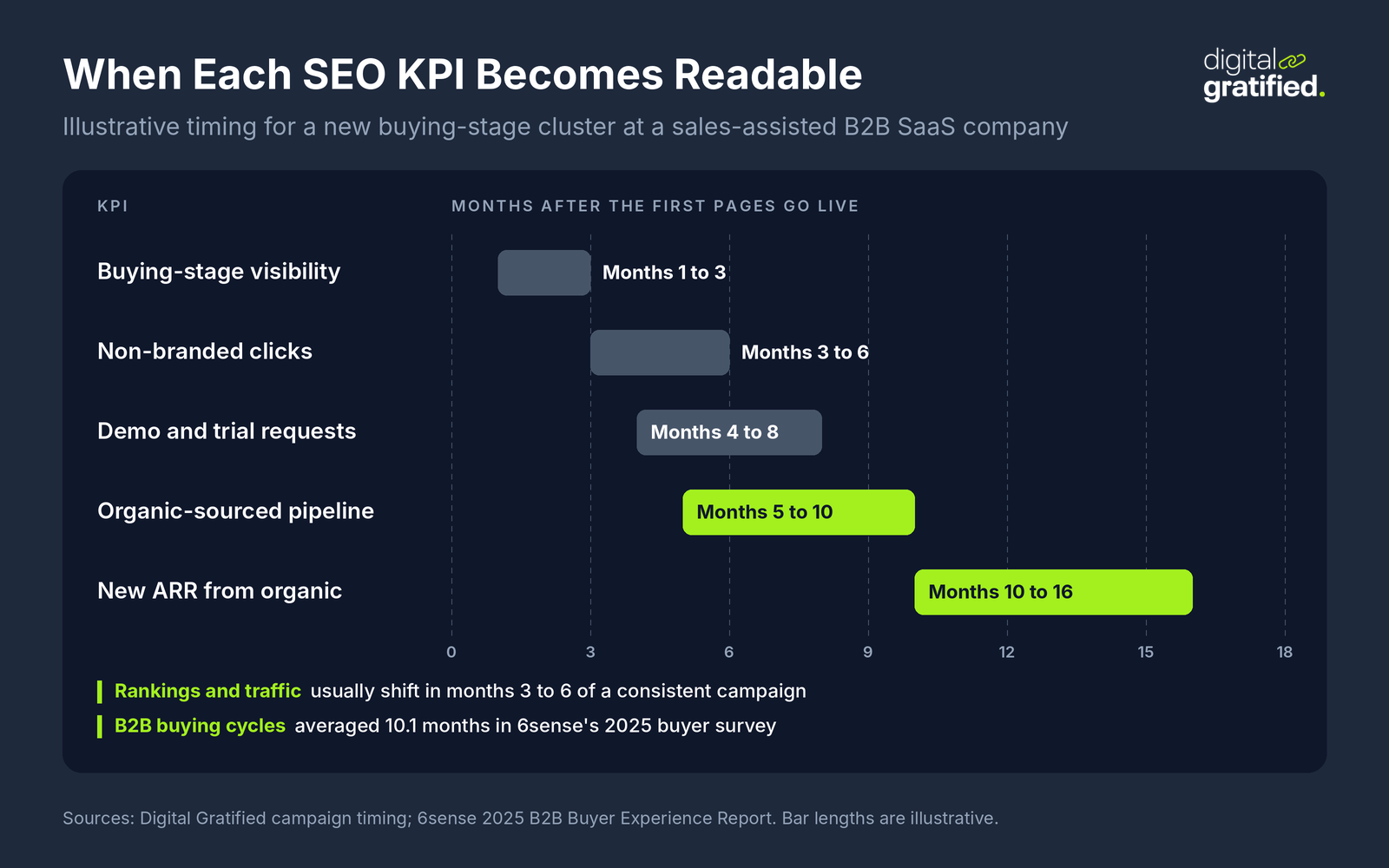
On our campaigns, measurable shifts in rankings and traffic typically appear between months 3 and 6. A buyer who first finds a comparison page in month 5 may not sign until well into the following year, because B2B buying cycles averaged 10.1 months in the buyer survey cited earlier. So judge each quarter on the KPI that should be readable by then: visibility in quarter one, clicks and demo requests in quarter two, pipeline from quarter three, ARR at the one-year review.
How to Track SEO KPIs in AI Search
AI search changes the visibility KPI more than the others. Search Console's AI performance reports, which Google rolled out to all users worldwide at the end of August 2026, show impressions in AI Overviews, AI Mode and other AI responses by page, country, device and date. They do not include clicks. That makes AI impressions a visibility measure, not a traffic one, and they belong in KPI 1 next to top 10 coverage.
Three adjustments keep the scorecard accurate:
- Add AI impressions for the buying-stage pages to KPI 1. A comparison page that appears in AI answers for "best expense software for startups" is doing its job even when the click never comes.
- Watch branded demand as a lagging signal of AI visibility. If AI answers cite you, more buyers search your name later. Track branded clicks as a diagnostic beside KPI 2, not inside it.
- Sample AI citations on a fixed prompt set. Run the same 20 to 30 buyer prompts each month in the AI tools your buyers use and record whether you are cited. Report it as a sample, never as a share of all AI answers.
The work that earns those citations is the same work that earns rankings, with more weight on being the clear source for each subtopic. We cover it in our guide to getting SaaS brands cited by AI search tools.
Weekly, Monthly and Quarterly: How Often to Review SEO KPIs
Each KPI has a natural review rhythm, and reviewing a slow one too often creates noise that leads to bad decisions.
- Weekly (15 minutes): check for breakage, not performance. Tracking still firing on demo forms, no indexing drops on commercial pages, no sudden fall in buying-stage visibility. Nobody needs a deck for this.
- Monthly: report KPIs 1 to 3 against target, with page-group detail and a short diagnosis of the biggest movement. This is the report the marketing lead reads.
- Quarterly: review pipeline and ARR, compare them with the forecast, and decide where next quarter's content and link budget goes. This is the report the CEO and CFO read.
Our guide to turning SEO KPIs into a monthly report leadership reads covers the structure, the uncertainty notes and the action list that should sit around these numbers. When content is a large share of the spend, attributing content to revenue without inventing precision covers the attribution choices in more depth.
How SEO KPIs Change by Company Stage and Sales Motion
The chain stays the same; the weight on each link changes.
Product-led companies with self-serve trials should swap demo requests for activated signups, because a trial that never reaches its first meaningful action is not pipeline. Their ARR KPI also arrives faster, since many deals close on a credit card within the trial window.
Sales-led companies selling six-figure contracts should give the most weight to KPIs 1 and 4. Deal counts are small, cycles are long, and buying-stage visibility is the best early evidence that search is reaching the committee. Our guide to which buying-stage pages a B2B site needs first explains how to build the query set for KPI 1.
Early-stage companies without enough deals to measure win rates should report KPIs 1 to 3 and treat pipeline as a quarterly observation until volumes are meaningful. Claiming ARR from three deals invites the wrong conclusions in both directions.
This is how we run SaaS SEO engagements: the keyword plan is built around buying-stage queries, and every monthly report from our SaaS SEO team shows what was built, what moved and what it means for pipeline. For the strategy those KPIs sit inside, from technical foundations to content and links, see our SaaS SEO guide to strategy, execution and ARR.
The Bottom Line
A SaaS SEO program needs five KPIs that form one chain: buying-stage visibility, non-branded clicks to buying pages, demo and trial requests, organic-sourced pipeline and new ARR. Everything else is a diagnostic that explains why the chain moved.
So rebuild your scorecard this quarter. Fix the buying-stage query set, split branded from non-branded clicks, connect form data to your CRM, and set targets backwards from the ARR goal finance has already agreed. Then judge each KPI only once it has had time to move. If you want a team to set up and run that measurement with you, plan your SEO KPIs with our SaaS SEO team.
Frequently Asked Questions
What are SEO KPIs?
SEO KPIs are the few measurable targets that show whether organic search is reaching a business goal. For a B2B SaaS company they should run from buying-stage visibility through non-branded clicks to buying pages, demo and trial requests, organic-sourced pipeline and new ARR. Other SEO metrics are diagnostics that explain why those KPIs moved.
What is the difference between an SEO metric and an SEO KPI?
A metric is any number you can measure, such as impressions or average position. A KPI is a metric tied to a business goal, with a target, an owner and a review date. If a number moving would not change your plan, it is a metric or a diagnostic, not a KPI.
How many SEO KPIs should you track?
Report three to five. More than that and the report stops guiding decisions. A SaaS team can cover the whole chain from search to revenue with five, and keep rankings, traffic, backlinks and technical health as diagnostics in an appendix.
Is organic traffic a good SEO KPI?
Not on its own. Total organic sessions mix buyers with students, job seekers and logged-in customers, and AI answers now absorb many clicks. Non-branded clicks to commercial pages such as comparison, pricing and product pages are a far better KPI for a SaaS company.
What weekly SEO metrics should you measure?
Use the weekly check to catch breakage rather than judge performance: confirm demo and trial tracking still fires, look for indexing drops on commercial pages, and watch for a sudden fall in visibility on your buying-stage queries. Judge KPIs monthly and pipeline quarterly.
How do you measure SEO success in AI search?
Add AI impressions for your buying-stage pages from Search Console's AI performance report to your visibility KPI, since that report shows impressions but not clicks. Sample citations on a fixed set of buyer prompts each month, and watch branded search demand as a lagging sign that AI answers mention you.
How long does it take for SEO KPIs to show results?
Visibility on buying-stage queries can move within one to three months. Rankings and traffic usually shift in months three to six of a consistent campaign, demo requests follow, and pipeline and ARR lag by a full B2B sales cycle, which often runs most of a year.
About the author
Let's Scale Your SaaS Together
Get a custom SEO and link building strategy tailored for your SaaS business.
Get SEO insights that actually move rankings
Link building tactics, case studies, and SaaS SEO playbooks. No fluff, no spam.
You're subscribed!
SEO and link building insights, straight to your inbox.