Most lists of SaaS marketing agencies are written by an agency that ranks itself first. Here is how to pick the right agency model for your team, what agencies charge, a scorecard for proposals and the red flags to catch before you sign.

Founder, Digital Gratified
A SaaS marketing agency is an outside team that runs part or all of a software company's marketing: positioning, content, SEO, paid acquisition, demand generation or the whole funnel. Our position is that most B2B SaaS companies should not hire one to "do marketing." Hire an agency to remove one specific constraint on pipeline, keep the strategy and the pipeline number in-house, and sign a contract you can leave after 90 days if the work does not show up in your CRM.
Most pages that rank for this term are lists of agencies written by an agency that ranks itself first. That tells you who exists, not who fits. This guide covers what a SaaS marketing agency does, the four models you can buy, what agencies charge, a scorecard for comparing proposals, the red flags we would look for in a pitch, and how to hold the agency you pick accountable. It assumes you have already done the work of deciding your B2B SaaS marketing strategy first, because an agency can execute a strategy far more reliably than it can invent one for you.
What Is a SaaS Marketing Agency?
A SaaS marketing agency is a marketing firm whose clients are mostly software companies sold on subscription. The label covers very different businesses. Some are full-service firms that take on positioning, website, content, paid media and marketing operations. Others do one channel, such as SEO, paid search, LinkedIn ads, content or digital PR, and only for software companies. A third group sells senior leadership on a part-time basis, usually called a fractional CMO or go-to-market advisory.
What makes an agency a SaaS agency is not the client list. It is whether the team understands how recurring revenue changes the job. A SaaS buyer often starts with a free trial or a demo, involves several people in the decision, and pays monthly for years, so the value of a customer is decided long after the first click. An agency that reports leads and traffic without asking about trial conversion, sales cycle length or net revenue retention is a general agency with SaaS logos on its site. If your team needs a refresher on those mechanics, start with how the B2B SaaS model sells.
Do You Need a SaaS Marketing Agency?
You need one when you can name the constraint it will remove. "We need more leads" is a symptom. "Our comparison pages rank on page three," "we have no one who can run LinkedIn ads," or "our trial signups convert to paid at half the rate they did last year" are constraints, and each points to a different kind of agency.
You probably do not need one yet when the product has no repeatable buyer, when nobody in the company can say which customers close fastest, or when the only goal is to look busier in a board deck. An agency will happily produce activity in all three cases. It cannot produce product market fit.
Budget pressure makes the question sharper. Marketing budgets have held at 7.7% of company revenue for two years running, and 39% of CMOs plan to cut agency budgets, according to the Gartner 2025 CMO Spend Survey of 402 marketing leaders. When budgets are flat, an agency retainer competes directly with a hire, a tool and your ad spend. It should win that comparison on pipeline, not on the number of deliverables in the proposal.
The Four Kinds of SaaS Marketing Agency
Agencies sell four basic models, and each one assumes something different about the team you already have. The table sets them side by side.
| Model | Best when | What you keep in-house | Main risk | What to measure |
|---|---|---|---|---|
| Full-service SaaS agency | You have no marketing team and a budget that can carry several channels at once | Final say on positioning and the pipeline target | The agency sets the strategy and grades its own work | Pipeline and CAC by channel, from your CRM |
| Channel specialist (SEO, paid, content, PR) | One channel is the clear bottleneck and you have someone to own the rest | Strategy, budget split and the other channels | Each specialist optimizes its own channel and ignores the others | The one channel metric tied to pipeline, such as demos from organic search |
| Fractional CMO or GTM advisor | You need a strategy and someone to hire and manage the work | Execution, through hires, freelancers or specialists | Advice without enough hands to carry it out | Decisions made and shipped each quarter |
| Freelancer network or productized service | The work is defined and repeatable, such as a set number of articles or ads a month | Strategy, briefs, editing and quality control | Output volume with no link to outcomes | Cost per usable asset and its conversion rate |
The models are not ranked. The right one depends on two things: whether you have someone senior who owns marketing, and whether your problem sits in one channel or across the funnel. The matrix below maps those two questions to a starting choice.
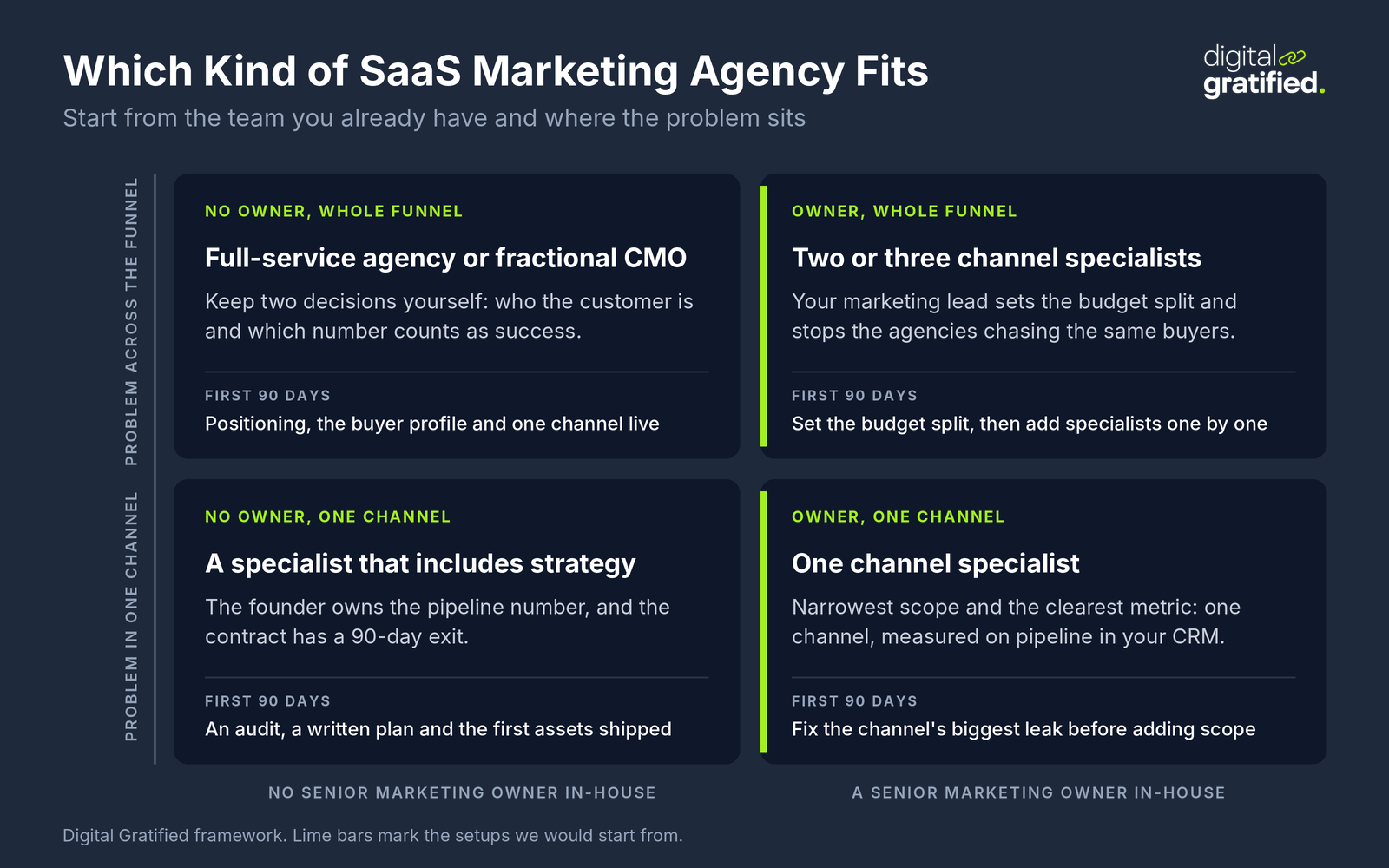
The quadrant most founders land in by accident is the top left: no marketing leader and a problem across the whole funnel, solved by hiring a full-service agency and hoping. It can work, but only if you keep two decisions for yourself: who the customer is and what number counts as success. Hand those over and you have bought a team that sets its own targets. If you are weighing choosing between DIY, a freelancer and an agency for search specifically, the same logic applies at a smaller scale.
Full-Service or Specialist?
For most B2B SaaS companies past their first marketing hire, we would pick specialists. A full-service agency has to staff every channel, so its strongest people tend to work on its largest accounts, and its weakest channel drags down the whole program. A specialist lives or dies on one channel and usually has deeper benchmarks for it. The cost of specialists is coordination: someone on your side has to decide the budget split and stop the SEO agency and the paid agency from bidding against each other for the same buyers.
Full-service makes more sense before that first hire, or when brand, website and launch work all have to move together in a single quarter. Even then, ask which channels the agency does in-house and which it subcontracts. You are entitled to know who does the work.
How Much Does a SaaS Marketing Agency Cost?
Most agency retainers are smaller than SaaS founders expect, and most relationships last longer than the contract term. In SparkToro's 2025 State of Digital Agencies survey, 86% of agencies said their average monthly retainer was up to $10,000: 49% in the $1,000 to $5,000 band and 31% between $5,000 and $10,000. Only 10% reported $25,000 to $50,000, and retainers that large came only from agencies in North America and Europe. On length, 31% said a typical client stays more than three years and 25% said less than 12 months.
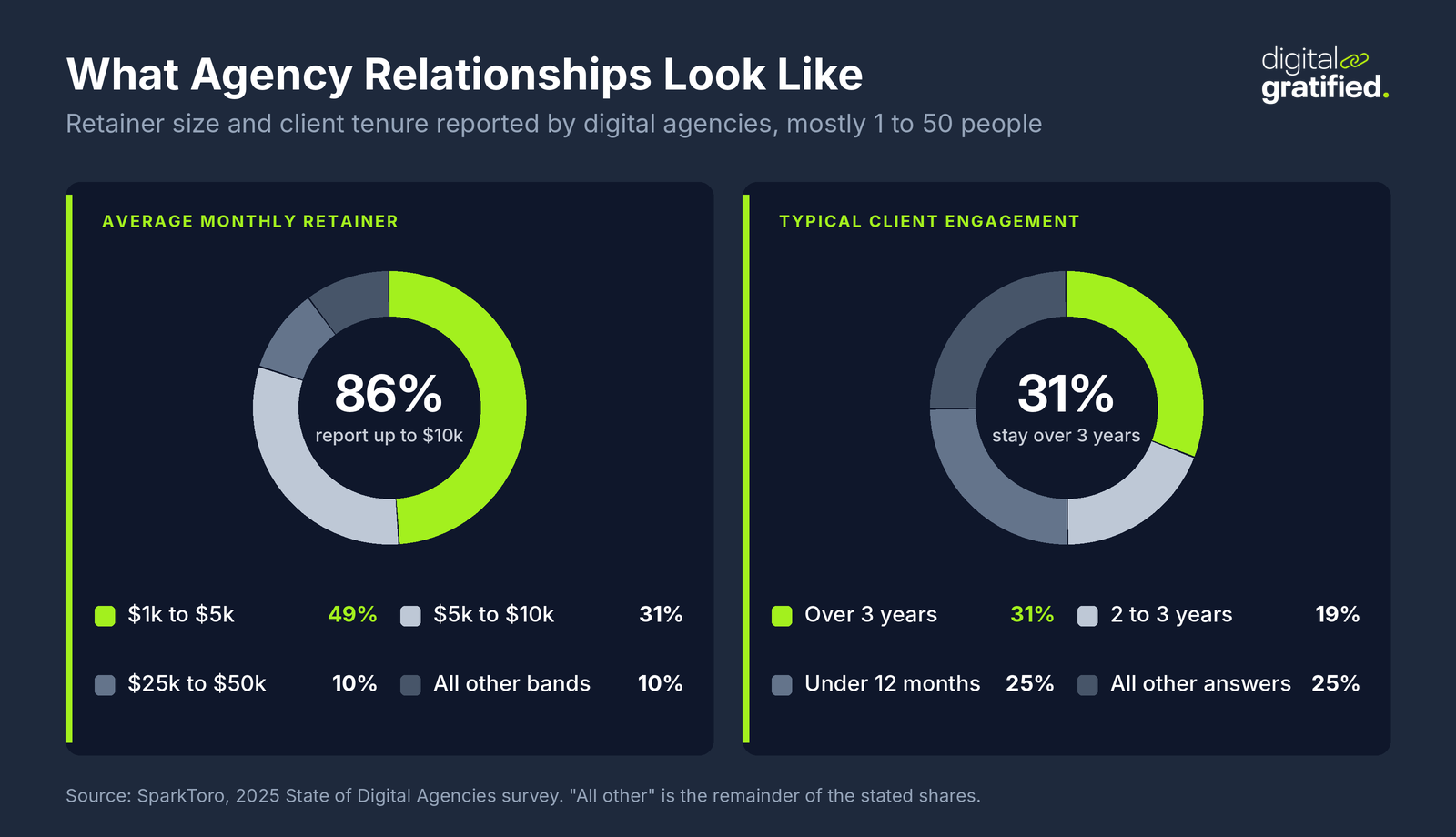
The survey skews toward agencies of 1 to 50 people, so read it as a picture of the market a SaaS company at seed to Series B shops in, not of the holding company firms that serve enterprise brands. Treat it as a market range for planning, and expect full-funnel programs with paid media management and a senior strategist to sit toward the top of it or above.
Price the retainer against your own budget, not against the agency's other clients. A $15,000 monthly retainer is $180,000 a year; at the 7.7% average, that is nearly half the entire marketing budget of a company with $5 million in revenue. Compare it with benchmarks for how much SaaS companies spend on marketing at your stage, and leave room for ad spend and tools, which almost never sit inside the retainer.
Retainer, Project or Performance Pricing?
Retainers suit work that compounds, such as SEO, content and link building, where month three builds on month one. Projects suit work with an end, such as a website rebuild, a positioning sprint or a launch. Performance pricing, where the agency is paid per lead or per meeting, sounds safest but tends to reward the cheapest lead the agency can count, not the buyer your sales team wants. If you use it, pay on sales-accepted opportunities from your CRM, not on form fills.
How to Choose a SaaS Marketing Agency
Most selection processes fail in the same place: the buyer compares agencies on their case studies and their deck, which are the two things every agency polishes. A better process compares agencies on how they would solve your specific constraint, with evidence you can check.
A Scorecard for SaaS Agency Proposals
Score each finalist from 1 to 3 on six questions and add the scores.
- Constraint fit. Does the proposal name your bottleneck in its first page and build the plan around it? A plan aimed at the constraint you described scores 3; a standard package with your logo on it scores 1.
- Pipeline measurement. Will the agency report from your CRM, using opportunities and revenue, or from its own dashboards using traffic and leads? CRM-based reporting scores 3.
- Comparable proof. Can it show results for a company at your stage, price point and sales motion, with a reference you can call? A named reference at a similar company scores 3; logos only score 1.
- The team you get. Does the proposal name the people who will do the work and how many hours each will spend? Named people with hours score 3; "a dedicated team" scores 1.
- Search and AI readiness. Can it explain how its work will show up in AI answers as well as in Google? Specific methods and examples score 3; a slide that says "GEO" scores 1.
- Exit terms. Can you leave after an initial period, and do you keep every account, asset and piece of content? A 90-day out with full ownership scores 3; a 12-month lock-in scores 1.
A finalist scoring 15 to 18 is worth a trial. One scoring 11 to 14 is worth a negotiation on the weak points. Anything at 10 or below is selling a package, not solving your problem.
The fifth question matters more each quarter. Half of B2B software buyers now start research with an AI chatbot more often than with Google, up from 29% a year earlier. An agency that plans only for blue links is planning for a shrinking share of your buyers' first touch. Ask how it would get your product named in an assistant's shortlist, and compare the answer with how SaaS brands get named in AI answers.
Questions to Ask Before You Sign
Google's own guidance on hiring an SEO is a useful starting point for any marketing agency, not just a search one. It suggests asking for examples of previous work, what results to expect and in what timeframe, how success will be measured, and whether the agency will share every change it makes. It also states plainly that no one can guarantee a first place ranking on Google, which makes any agency that promises one easy to rule out.
Add three SaaS questions of your own. Ask which of their current clients have the same sales motion as you, whether product-led, sales-led or a mix, because the playbooks differ. Ask what they would stop doing in month two if the early numbers disappoint. And ask what they would need from your team each week; an agency that needs nothing from you is planning to work without your product knowledge, and it will show in the content.
Red Flags in a SaaS Agency Proposal
The proposal is the best evidence you will get before signing, because it shows how the agency thinks when it is trying hardest.
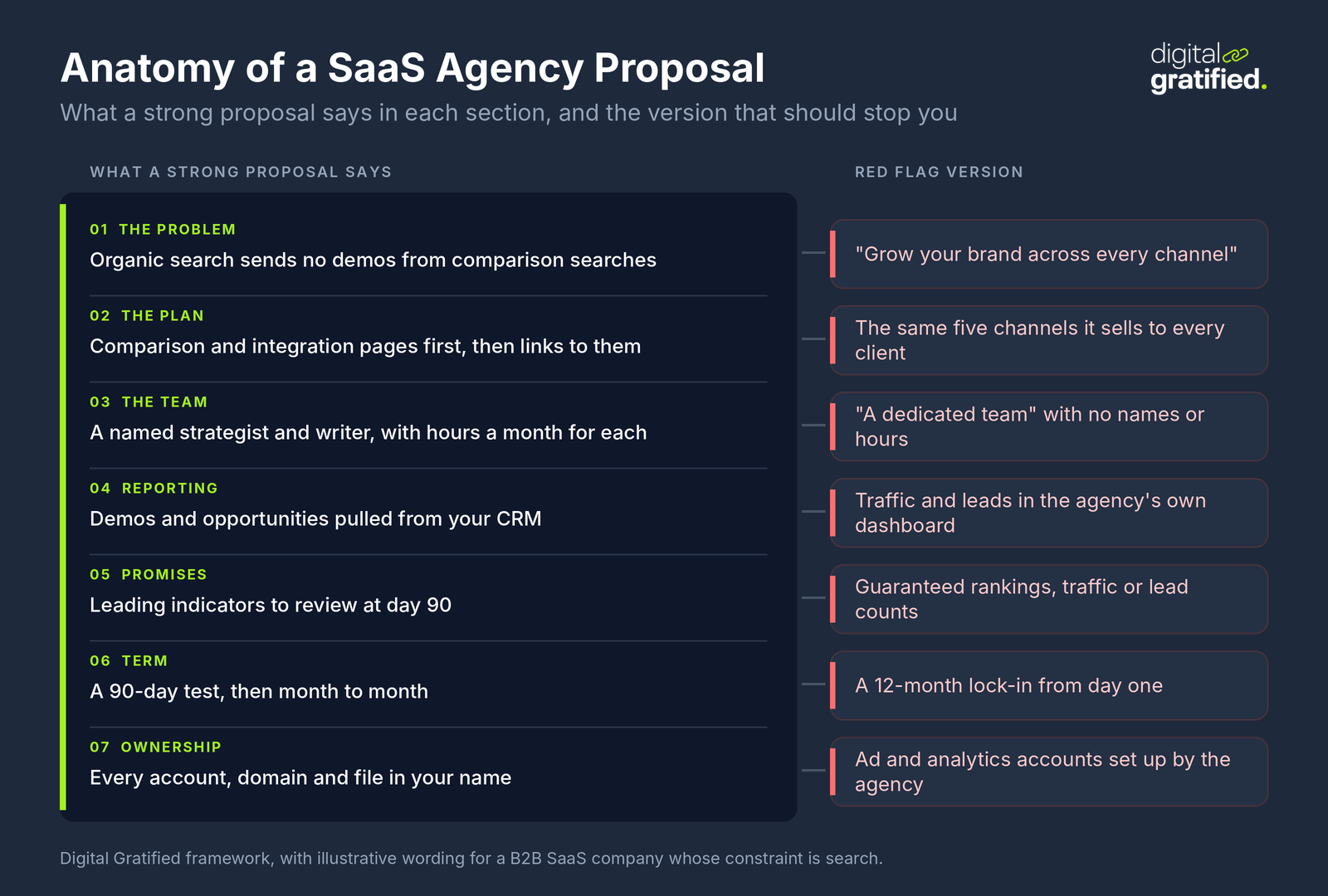
Guarantees are the clearest warning. A promise of a ranking, a traffic number or a fixed count of leads tells you the agency will optimize for whatever it promised, whether or not it turns into revenue. Close behind is a deliverables list with no outcome attached: twelve blog posts, eight social graphics and a monthly report describe effort, not progress. Watch for reporting that lives only in the agency's own dashboard, because you cannot check it against closed deals, and for ad accounts, analytics properties or domains set up under the agency's name, which make leaving expensive.
The quieter flag is a plan that would read the same for any client. If you could swap your company name for a competitor's and nothing else in the proposal would need to change, the agency has not done the thinking you are about to pay for.
How to Hold a SaaS Marketing Agency Accountable
Accountability starts before the kickoff call. Agree on one pipeline metric the agency is responsible for, such as sales-accepted opportunities from organic search or demos from paid social, and make sure it is measured in your CRM with a source field the agency cannot edit. Agree on two or three leading indicators that should move first, so you can judge month three before revenue shows up. Building reporting that ties organic search to pipeline once, on your side, makes every agency easier to manage.
Then run the first 90 days as a test, not as the start of a long contract. Set a review at day 90 against the leading indicators and a second review at month six against pipeline. Length is not the problem: the average client relationship with an integrated full-service agency runs 7.3 years. The problem is staying because leaving feels like admitting a bad hire.
Keep ownership simple. Every ad account, analytics property, CMS login, domain and content file should be in your company's name from the first day, with the agency added as a user. Ask for raw data exports monthly. None of this costs a good agency anything, and it turns the day 90 review into a business decision rather than a migration project.
A Worked Example: Three Proposals for One Series A Company
Here is a worked example with illustrative circumstances. A Series A company selling scheduling software to clinics has $4 million ARR, a sales-led motion with a 45-day average cycle, one marketing manager and a founder who still runs most deals. Demo requests come mainly from referrals and a few paid search campaigns. The board wants a second source of pipeline within a year.
Three agencies pitch. A full-service agency proposes a $22,000 monthly retainer covering a website refresh, content, paid social, SEO and a monthly report, with a 12-month term. A SaaS SEO and content specialist proposes $9,000 a month for comparison pages, integration pages and links, reported as demos from organic search in the company's CRM, with a 90-day out. A fractional CMO proposes $7,500 a month for two days a week to build the plan and manage freelancers.
On the scorecard, the full-service agency scores 11: strong on proof, weak on constraint fit and exit terms, because its plan is the same five channels it sells to every client. The specialist scores 16, because it names the constraint, which is that buyers search for clinic scheduling comparisons and find only competitors, and it reports from the CRM. The fractional CMO scores 13, with high marks for strategy and low marks for execution capacity.
The company hires the specialist and asks the marketing manager to own the budget split, with the founder reviewing pipeline monthly. It revisits the fractional option in six months, once it knows whether search can carry a second pipeline source.
Where a Specialist SEO and Link Building Agency Fits
Search is often the constraint for B2B SaaS companies that already have a sales team and a working product, because buyers research comparisons, alternatives and integrations long before they talk to sales. If that is your bottleneck, compare search specialists on the criteria in what separates a good SaaS SEO agency, and if links are the gap, look at link building agencies compared on price and link standards. For the broader question of which parts of search to keep in-house, use a decision framework for outsourcing SEO.
This is the part of marketing we do. We are not a full-service agency: we run SaaS SEO, link building, digital PR and authority content for B2B software companies, with placements only on sites with a Domain Rating of 50 or higher and never on PBNs or link farms, and clients approve the prospected domains before outreach starts. You can see how that work fits together on our SaaS SEO and link building page. If your constraint is paid media, positioning or lifecycle email, a specialist in that channel will serve you better.
Wherever the agency sits, its plan should follow the growth levers that fit your stage, not the services it happens to sell. One timing note if you are judging search proposals this month: Google's November 2026 core update began rolling out on November 10, with Google saying the rollout could take up to two weeks, so any agency audit run during the rollout may show movement that has nothing to do with your site.
The Bottom Line
Hire a SaaS marketing agency to remove one named constraint on pipeline, not to own your marketing. Decide the customer and the success metric yourself, pick the agency model that matches the team you already have, score the finalists on constraint fit, CRM reporting, comparable proof, named people, AI readiness and exit terms, and run the first 90 days as a test.
If the constraint turns out to be search, with buyers comparing tools and finding only your competitors, talk to us about SaaS SEO and link building built around pipeline.
Frequently Asked Questions
What is a SaaS marketing agency?
It is a marketing firm whose clients are mostly subscription software companies. Some are full-service and run positioning, website, content, paid media and operations; others specialize in one channel such as SEO, paid search or content; and some sell part-time senior leadership as a fractional CMO.
How much does a SaaS marketing agency cost?
In SparkToro's 2025 survey of digital agencies, 86% reported an average monthly retainer of up to $10,000, with 49% between $1,000 and $5,000. Full-funnel programs that include paid media management and senior strategy cost more, and ad spend and tools are usually billed on top of the retainer.
What should I look for when hiring a SaaS marketing agency?
Look for a proposal that names your specific constraint, reports pipeline from your CRM, shows results for a company at your stage with a reference you can call, names the people doing the work, explains how it will show up in AI answers, and lets you leave after an initial 90-day period while keeping every account and asset.
Should a SaaS company hire a full-service agency or a specialist?
Once you have someone senior who owns marketing, specialists usually win, because each lives or dies on one channel. A full-service agency makes more sense before your first marketing hire, or when brand, website and launch work must move together, as long as you keep the customer definition and the success metric yourself.
How long does it take a SaaS marketing agency to show results?
Paid channels can show pipeline within a quarter; SEO and content usually take longer to reach revenue. Agree on two or three leading indicators to review at day 90 and judge pipeline at month six, so you can tell an early slowdown from a program that is not working.
How do I hold a marketing agency accountable?
Give it one pipeline metric measured in your CRM with a source field it cannot edit, set reviews at day 90 and month six, keep every ad account, analytics property and content file in your company's name, and ask for raw data exports each month.
What are red flags in a marketing agency proposal?
Guaranteed rankings, traffic or lead counts; a deliverables list with no outcome attached; reporting only in the agency's own dashboard; unnamed team members; long lock-in terms; and ad or analytics accounts set up in the agency's name. Google's own guidance says no one can guarantee a first place ranking.
About the author
Let's Scale Your SaaS Together
Get a custom SEO and link building strategy tailored for your SaaS business.
Get SEO insights that actually move rankings
Link building tactics, case studies, and SaaS SEO playbooks. No fluff, no spam.
You're subscribed!
SEO and link building insights, straight to your inbox.