Most SEO for startups advice is a small business checklist. Here is the B2B SaaS version: which pages to build first at each stage, how long ranking takes, how to pick keywords a new domain can win, and how to measure SEO before deals close.

Founder, Digital Gratified
SEO for startups works when you treat it as a pipeline channel with a long fuse: build the small set of pages buyers search for while they are choosing a product, then widen into content once those pages rank and convert. Our position for B2B SaaS founders is that the first 30 pages on your site should be use-case, comparison, alternatives and integration pages, not a blog, and that a startup should judge SEO by demo requests per page rather than by traffic.
Most guides that rank for this term are written for small businesses in general: set goals, research keywords, write posts, build links, repeat. That advice is not wrong, but it skips the questions a SaaS founder has to answer with limited runway. When is SEO worth starting? Which pages come first? What does a realistic first year look like, and how do you measure it before any deal closes? This guide answers those, stage by stage, with a worked example. Think of it as the early-stage version of the full SaaS SEO program you grow into later.
Should a Startup Invest in SEO?
Yes, if three things are true: buyers already search for the problem your product solves, someone on the team can give SEO steady hours every week, and you can wait 6 to 12 months for results that show up in pipeline. If one of the three is missing, put your main effort into another channel for now, and still do the SEO work that costs almost nothing to get right early: a site Google can crawl, accurate page titles, and one page for each main use case of the product.
The case for starting early is compounding. A paid search budget stops producing the day you stop paying. A comparison page that ranks keeps producing demo requests for years, and its cost per demo falls every month it holds its position. PostHog began serious SEO work about two years after it was founded, saw early movement at around three months and reported that its search traffic tripled within a year. Plan for slow, then useful.
The case for being selective is just as strong. Nearly every page on the web earns nothing from search: 96.55% of the pages in a 14-billion-page index get zero traffic from Google. The usual causes are no search demand, no backlinks and a mismatch with what the searcher wants, so every startup page needs a reason to exist before anyone writes it.
How Long Does SEO Take for a Startup?
Longer than a seed round's patience, unless you pick the right keywords. In a study of 2 million pages, only 5.7% of new pages reached the top 10 for at least one keyword within a year, and most of those got there in roughly 61 to 182 days. Just 0.3% did it for a high-volume keyword. The average page in position 1 was almost three years old.
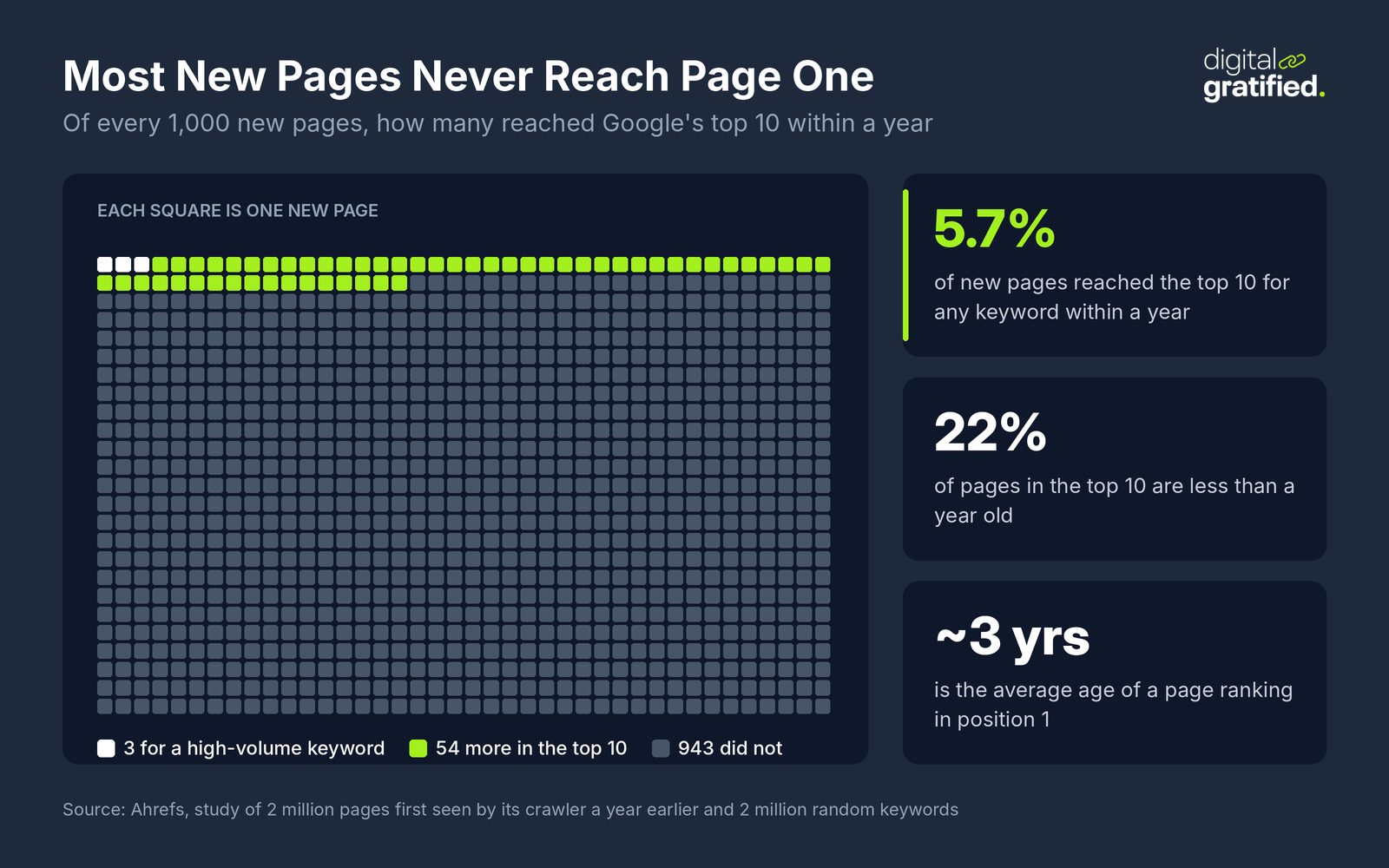
Read that as a rule about keyword choice, not a reason to give up. A new domain will not outrank a three-year-old guide for a head term in year one, but it can rank for a specific, low-competition search the big sites never answered well, and in B2B SaaS those searches are often closest to a purchase.
A realistic first year looks like this. In the first three months, pages get indexed and start collecting impressions for low-competition terms. Between months three and six, the best bottom-of-funnel pages reach the first page for their exact searches. Between months six and twelve, those pages start producing demo requests often enough to see in your CRM. Anyone who promises faster results for competitive terms is selling something you should not buy; Google's own advice on hiring an SEO says that no one can guarantee a first place ranking.
How Startup SEO Differs for B2B SaaS
A B2B SaaS buyer behaves differently from the buyer generic startup advice assumes, in four ways that each change the plan.
The valuable keywords are small. A search like "SOC 2 readiness assessment" shows a few hundred searches a month, and nearly everyone typing it is close to a purchase. A startup that filters out anything under 1,000 searches filters out most of its future customers.
Several people search. The engineer, the security lead and the person who approves the budget each look for something different: how it works, whether it is safe, what it costs. Pricing, security and integration pages matter more than most founders expect.
The deal closes months after the visit. A demo requested in March may close in August. If you judge SEO only by closed revenue in its first two quarters, it will always look like it is failing.
Buyers increasingly start in an AI answer. In G2's survey of 1,076 software buyers, 51% now start their research with an AI chatbot more often than with Google, up from 29% a year earlier. On Google itself, AI Overviews cut the click-through rate of the top result by 58% across 300,000 keywords. Both trends hit definitions and generic explainers hardest, because a summary answers them. Pages that help a buyer compare, price or choose a product still get the visit, and they give an assistant something specific to cite, which is how a startup earns a place in AI answers for its category without a large content library.
SEO for Startups, Stage by Stage
The right amount of SEO depends on how much you know about your buyer. The table sets out what we would do at each stage of a B2B SaaS startup.
| Stage | Main SEO goal | Pages to build | Links | What to measure | Who does the work |
|---|---|---|---|---|---|
| Before product market fit | Be findable for your name and the problem you solve | Home, pricing, one page per use case, basic docs | Launch listings, partners and investors who already know you | Impressions on problem searches; demo requests by landing page | A founder, 2 to 3 hours a week |
| Seed | Win the buyer searches larger competitors ignore | Comparison, alternatives, integration and use-case pages, then a first cluster of problem guides | A few relevant links pointed at the pages that sell | Clicks to buyer pages; demo requests from organic search | One owner, plus freelancers for specific jobs |
| Series A | Turn a working channel into a predictable one | A cluster for each use case, original data, refreshed comparison pages | A steady editorial link program | Organic pipeline and its share of total pipeline | A marketer who owns SEO, with a specialist agency or contractors |
Before Product Market Fit
Do the minimum well and stop. You do not yet know which customers close fastest or which words they use, so a content plan written now will be rewritten in six months. Make sure the site is indexable, that each use case has its own page with a clear title, and that every demo request records the page it came from.
Seed Stage
This is where SEO starts paying for itself, and it is the stage most startups get wrong by launching a blog. Build the pages a buyer reads in the week before a demo: how you compare with the two competitors prospects mention most, alternatives pages for the tools they are leaving, one page for each integration they ask about, and one page for each use case. Only then start a cluster of guides around the problem you solve. If you are deciding whether to do it yourself, hire a freelancer or sign an agency at this point, team hours and runway should decide it, not ambition.
Series A
Once organic search produces demo requests you can see in the CRM, the job changes from finding what works to doing more of it on schedule: a cluster for each use case, data only your product can produce, comparison pages refreshed as competitors change pricing, and a steady link program. Hire someone who owns the channel and reports on pipeline.
The First Pages a SaaS Startup Should Build
The difference between a startup that gets pipeline from search in year one and one that does not is rarely effort. It is where the first 30 pages go and how they link to each other.
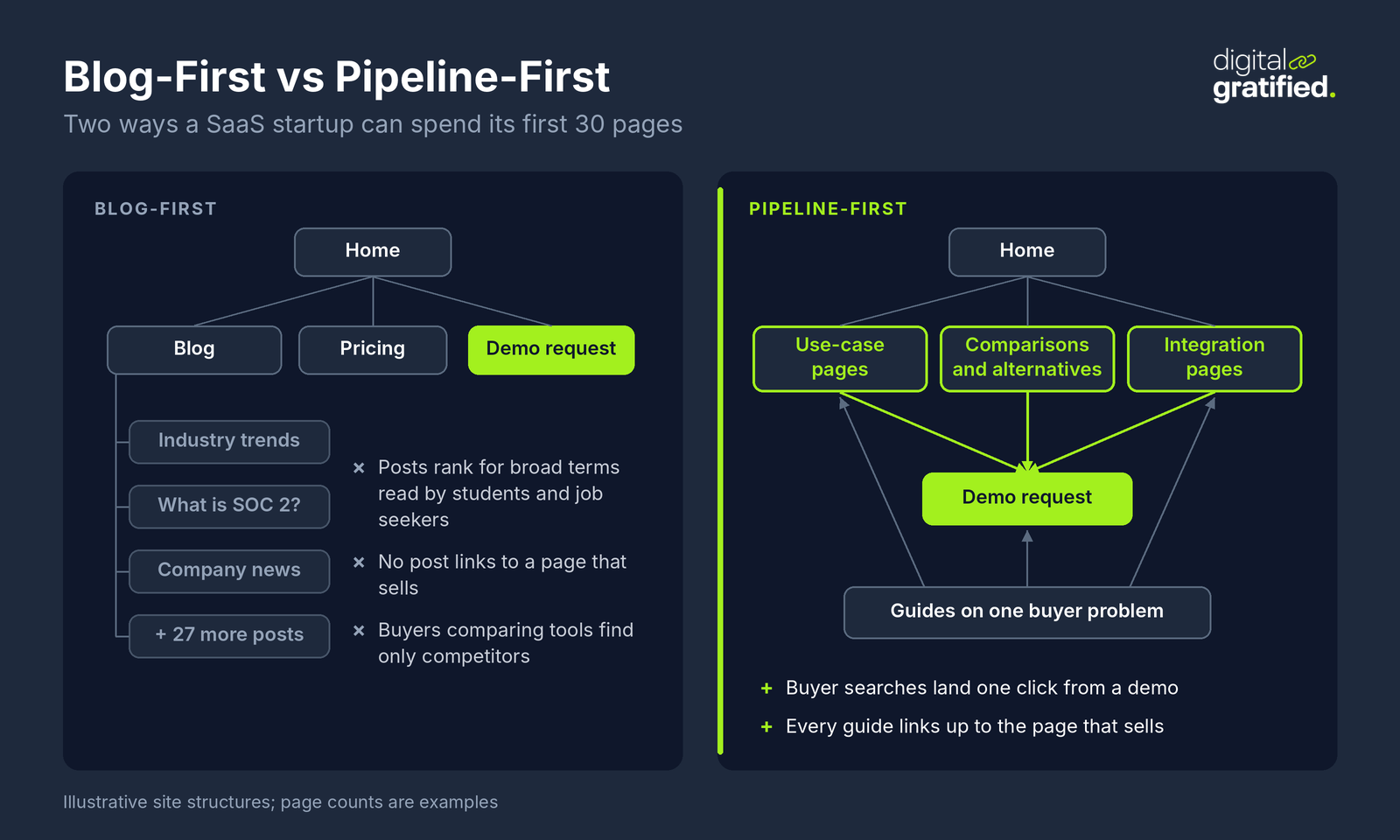
The blog-first site feels like progress, with a post a week and a traffic chart that moves, but definitions and trend pieces attract students, job seekers and other vendors' marketers. The pipeline-first site has less traffic in month six, and far more of its visitors are evaluating a purchase.
Comparison and Alternatives Pages
Buyers search "[competitor] alternatives" and "[your product] vs [competitor]" whether or not you publish anything. If you do not, the only answers they find are written by your competitors. These pages tend to have low volume, low competition and very high intent, which makes them the best first bet for a new domain. Write them fairly: say who the competitor suits better, show pricing from their pricing page, and be specific about the difference that matters.
Use-Case and Integration Pages
Each use case your product serves deserves a page that ranks for the way buyers describe that job, and each integration deserves a page that ranks for "[your category] for [tool they already use]". They convert well because the searcher has already decided what they need. For the structure and copy of these pages, see landing pages built to rank and to convert.
One Cluster of Guides on the Problem You Solve
When the commercial pages exist, start publishing guides, but on one problem at a time. Ten guides that cover one subject in depth, all linking to the matching use-case page, do more for a new domain than forty posts spread across the industry. That depth is what search engines read as expertise, and it is the logic behind covering one problem area in depth before the next. Write each guide from what your team knows and a generalist writer does not. Google's guidance on creating helpful content asks whether a page shows "first-hand expertise and a depth of knowledge" and whether it provides "original information, reporting, research, or analysis." A startup's sales calls, support tickets and product data are full of both.
Keyword Research for Startups: Small, Specific and Close to the Sale
A startup should do keyword research backwards: start from the words customers use and check the numbers afterwards, rather than starting from the biggest numbers and hoping they fit. Collect phrases from sales calls, demo forms and support tickets, then look each one up in a keyword tool. The map below shows why this works, using real US data for searches around SOC 2 compliance.
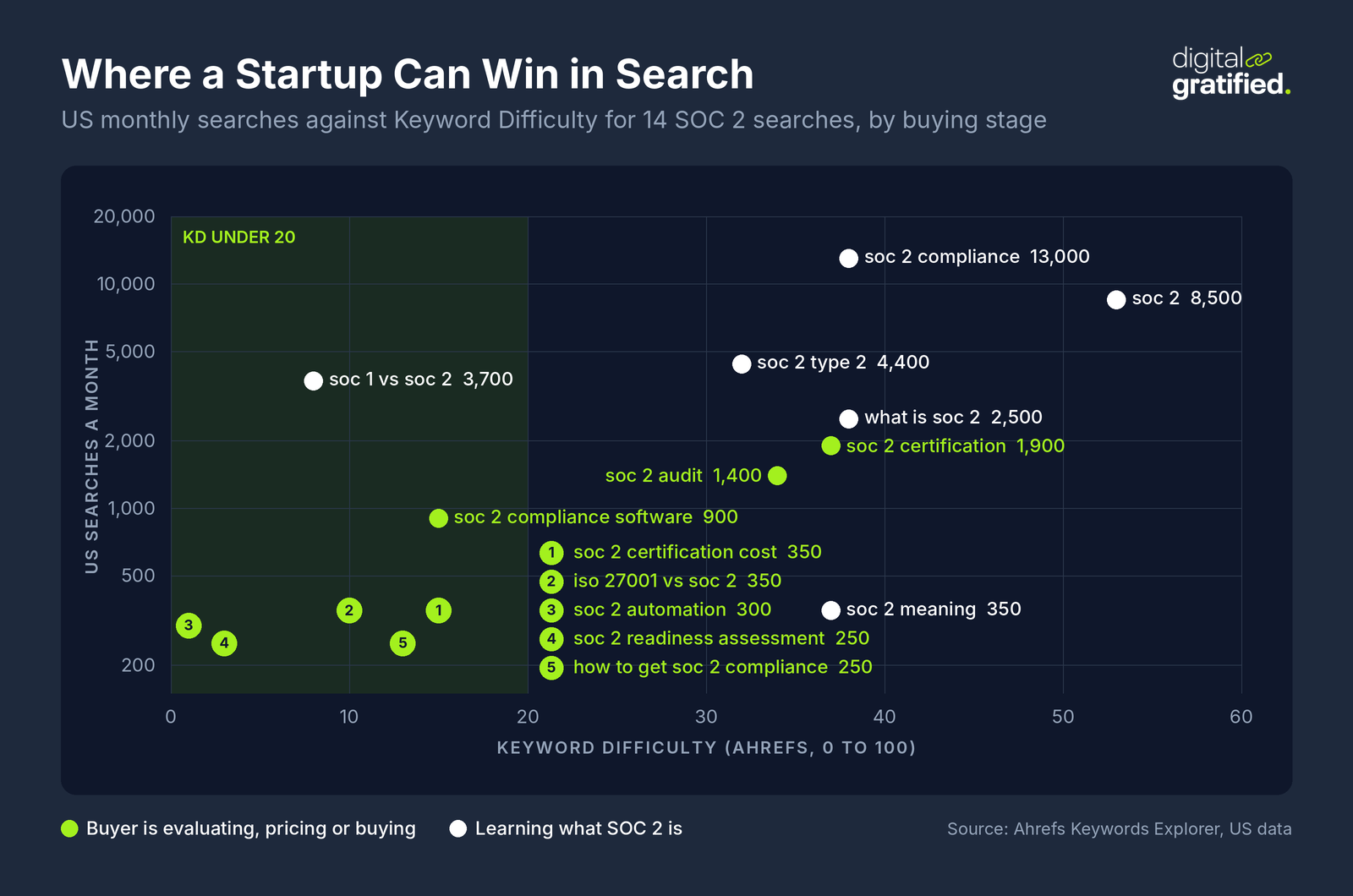
In most B2B categories the shape is similar. The large terms are definitions, with difficulty scores in the 30s to 50s, and they are exactly the searches AI Overviews now answer on the results page. Most of the searches a buyer makes while shopping, such as automation, readiness, certification cost and how two standards compare, sit under a difficulty of 20 with a few hundred searches each. Difficulty in Ahrefs Keywords Explorer is based on the backlinks of the pages already ranking, so a low score means a new domain with a handful of good links has a real chance.
Use three filters before a keyword goes on the plan. Would someone searching this be a plausible buyer within a year? Can the page that answers it link naturally to a product page? Can you write it from knowledge your competitors do not have? A keyword that passes all three is worth writing even at 50 searches a month. Once pages start collecting impressions, Search Console data replaces guesswork, because it shows the exact phrases Google already associates with your site.
Technical SEO a Startup Should Get Right Once
Technical SEO for a startup is a one-time setup with a short checklist, not a monthly retainer. The failures we see most often on young SaaS sites are specific: a marketing site built in a JavaScript framework that ships empty HTML to crawlers, a staging site that Google indexed alongside the real one, documentation on a subdomain nobody added to Search Console, and the same page reachable at several addresses. Each one can stop the right page from ranking at all, and each takes hours, not months, to fix. Work through the crawl and rendering checks a SaaS site needs before launch and again after any rebuild.
How a New Domain Earns Its First Links
A new site needs some links before even low-difficulty pages rank, and a startup has sources most companies have to work for. Integration partners often list apps in a marketplace or directory with a link. Investors, accelerators and customers publish portfolio pages and case studies. And a startup's product data, published as a benchmark or report, gives journalists and bloggers something new to cite. Point those links at the pages that sell, not only at the home page. For more tactics, see ways a SaaS site can earn backlinks.
The shortcut to avoid is buying cheap packages. Google's spam policies list "buying or selling links for ranking purposes," "excessive link exchanges" and "low-quality directory or bookmark site links" as link spam. A new domain has little authority to absorb a penalty or a wasted budget, so these risks cost a startup more than they cost an established brand.
When there are pages worth linking to, this is the kind of work we do for SaaS clients: editorial placements on sites with a Domain Rating of 50 or higher, never on PBNs or link farms, with the list of prospected domains shared for the client's approval before any outreach starts. You can see how that fits together on our SaaS SEO and link building page.
How to Measure Startup SEO Before It Shows in Pipeline
The measurement problem for a startup is that its numbers are small. Search Console's branded and non-branded query filter, which separates searches for your name from searches for your category, isn't available for sites with a low number of impressions, so many young sites cannot use it. Export your queries each month and tag the ones that contain your brand yourself; non-branded clicks are the number that shows SEO is reaching new buyers.
Set up the pipeline side on day one, because it cannot be added later. Every demo request and trial should record its original source and landing page in the CRM, so that when a deal closes in month nine you can still see that it began on a comparison page in month two. In between, watch three leading indicators: impressions on your buyer pages, average position for the searches those pages target, and demo requests per landing page. Those are the leading indicators worth tracking before revenue shows up, and they tell you by month four whether the plan is working.
Be careful reading short-term changes. Google's November 2026 core update started on November 10 and finished rolling out on November 24, so compare rankings from before November 10 with rankings from the end of the month, not with the days in between.
A Worked Example: A Seed-Stage Compliance Startup
Here is a worked example with illustrative circumstances, using the keyword data in the map above. A seed-stage company of eight people sells SOC 2 automation to other startups. The founder can give SEO three hours a week, and the company can fund a freelance writer for two pieces a month.
The team does not target "soc 2 compliance," with 13,000 searches and a difficulty of 38, in its first year. It builds the pages buyers read while shopping: a SOC 2 automation page (difficulty 1), a readiness assessment page that explains its own process (difficulty 3), a certification cost page with the price ranges its sales team quotes every week, an ISO 27001 vs SOC 2 comparison (difficulty 10), and alternatives pages for the two vendors prospects mention most. Each page ends with a demo request, and each records its landing page in the CRM.
In months four to nine, the freelancer writes a cluster of guides on the audit process, each linking to the readiness and automation pages. The founder asks the company's audit partners and integration partners to list the product with a link, and publishes a short benchmark on how long first audits take across the company's customers. The team judges progress by impressions and positions on the buyer pages until month six, then by demo requests from organic search. Security buyers weigh credibility heavily, so when we run link building for cybersecurity SaaS companies, we pitch named security and IT publications with real editorial teams and build link clusters around frameworks such as ISO 27001.
What a Startup Should Skip in Year One
Skip the high-volume definitions; they are the hardest terms to win and the ones AI Overviews answer for free. Skip news posts and company announcements as an SEO tactic, since almost nobody searches for them. Skip programmatic pages generated by the thousand until you know which template converts, and skip any link package priced by the dozen. Most of these are on the list of mistakes that cost early SaaS teams a year, and every one of them takes hours away from the 30 pages that will produce pipeline.
The Bottom Line
Treat SEO as a slow channel you start early and scale late. Before product market fit, make the site crawlable and give every use case a page. At seed, build comparison, alternatives, integration and use-case pages before any blog, pick keywords from customer language with difficulty under 20, and record the landing page of every demo request. Scale into clusters, data and steady link building only when search produces pipeline you can see in the CRM.
If your buyer pages exist and need authority to rank, talk to us about SaaS link building for pages that produce demos.
Frequently Asked Questions
What is SEO for startups?
It is search engine optimization planned around a startup's limits: a new domain with few links, a small team and limited runway. For a B2B SaaS startup that means building the pages buyers search for while choosing a product, such as comparison, alternatives, integration and use-case pages, before investing in a blog.
When should a startup start SEO?
Do the basics from launch: a crawlable site, clear page titles and one page per use case. Start a real SEO program once buyers search for the problem you solve, someone can give it steady hours each week, and you can wait 6 to 12 months for results in pipeline. For most B2B SaaS companies that is around the seed stage.
How long does SEO take for a startup?
Plan for early rankings on low-competition buyer searches in three to six months and demo requests you can see in your CRM in six to twelve. In Ahrefs' study of 2 million pages, only 5.7% of new pages reached the top 10 for any keyword within a year, so keyword choice decides how fast a startup sees results.
What pages should a SaaS startup build first for SEO?
Comparison pages against the competitors prospects mention, alternatives pages for the tools buyers are leaving, one page per integration and one per use case. These searches have low volume, low competition and high buying intent. Add a cluster of guides on one problem once those pages exist, with each guide linking to the matching product page.
Should a startup do SEO itself or hire an agency?
Before product market fit, a founder with two to three hours a week can cover the basics. At seed, one owner plus freelancers for specific jobs usually works best. An agency makes sense once organic search produces demo requests you can see and you can fund the work for at least a year.
How should a startup measure SEO?
Record the original source and landing page of every demo request in your CRM from day one. Until deals close, track impressions and average position for your buyer pages and demo requests per landing page. Tag branded queries yourself, because Search Console's branded filter is not available for sites with a low number of impressions.
Does SEO still work for startups with AI search?
Yes, but the payoff has moved toward buyer pages. AI Overviews answer definitions on the results page, while comparison, pricing and integration pages still get the click and give AI assistants specific facts to cite when buyers ask for a shortlist.
About the author
Let's Scale Your SaaS Together
Get a custom SEO and link building strategy tailored for your SaaS business.
Get SEO insights that actually move rankings
Link building tactics, case studies, and SaaS SEO playbooks. No fluff, no spam.
You're subscribed!
SEO and link building insights, straight to your inbox.